
Biological insights of the future come from cryoEM today
The medical discoveries of tomorrow are built on the biological insights coming to light today. Many structural biology discoveries are focused on these fundamental mechanisms of how cells function in the human body and across many forms of life.
Researchers are gaining fundamental knowledge about our bodies and the basic mechanisms of life using technologies that provide an up-close look at flash-frozen samples. In the Institute of Structural Biology at Penn Medicine, scientists have made breathtaking discoveries in recent years using cryogenic electron microscopy (cryoEM) and cryo-electron tomography (cryoET) that deepen this understanding of biology.
Take cell division. When a cell splits into two, it must first duplicate its chromosomes and then distribute them to the two new cells.
Kathryn Kixmoeller, PhD, an MD/PhD student at the Perelman School of Medicine who is now completing the MD portion of her studies, focused her research on this process, known as mitosis.
Each pair of duplicated chromosomes is joined at the middle by a region called the centromere, making them each look like the letter “X.” When it comes time to divide, rigid tubes called microtubules attach to the centromere at a protein complex called the kinetochore to separate the chromosomes into two identical halves, with one half of the X going to each new cell.
By directly visualizing this centromere region on an intact chromosome, Kixmoeller and her colleagues hoped to gain a better sense of how mitosis takes place. Kixmoeller’s graduate work was co-advised by Yi-Wei Chang, PhD, an assistant professor of Biochemistry and Biophysics and associate director of the Institute of Structural Biology, and Ben Black, PhD, a professor of Biochemistry and Biophysics.
A closer look: Delving into dividing chromosomes
Images of chromosomes as they prepare to split during cell division, or mitosis, show that the chromosomal material forms a “clearing” around the centromere at the center of the structure. This clearing allows the microtubule spindle to access to the centromere’s kinetochore protein complexes to pull the two halves of the X-shaped chromosome into two, one half for each new cell, thus ensuring equal distribution of genetic material into each cell. Source: Ben Black and Yi-Wei Chang laboratories, Penn Medicine.
Images of chromosomes as they prepare to split during cell division, or mitosis, show that the chromosomal material forms a “clearing” around the centromere at the center of the structure. This clearing allows the microtubule spindle to access to the centromere’s kinetochore protein complexes to pull the two halves of the X-shaped chromosome into two, one half for each new cell, thus ensuring equal distribution of genetic material into each cell. Source: Ben Black and Yi-Wei Chang laboratories, Penn Medicine.
Tucking into gene packaging
Meanwhile, biological systems are full of many more metaphorical football stadiums with many more seats that haven’t yet been pictured.
Much of Black’s team studies epigenetics—how organisms transmit heritable information to the next generation in ways that are not encoded in the DNA itself, but rather via modifications to genes or chromosomes.
This is also an area of interest for Kenji Murakami, PhD, an assistant professor of Biochemistry and Biophysics, who recently worked on a study of proteins, called histones, that keep DNA organized. The study was a collaboration with Ronen Marmorstein, PhD, the George W. Raiziss Professor in the Department of Biochemistry and Biophysics. Within the chromosome, DNA wraps around histone proteins to create a structure known as chromatin, which provides structure and aids with DNA replication and repair.
Murakami and Marmorstein study chaperone complexes that help histones find their rightful places in the chromatin. Marmorstein’s focus is on a human histone chaperone protein complex called HIRA, and Murakami’s lab studies a similar version of the protein, called Hir, in yeast.
Using cryoEM single particle analysis, the team produced high resolution images showing how the Hir complex assists with organizing the placement of histones in the chromatin. The study, published in Molecular Cell in 2024, was the work of a research team that included Hee Jong Kim, PhD, who is now a postdoctoral researcher at UCLA and conducted the work while co-advised by Murakami and Benjamin Garcia, PhD, who is now at Washington University in St. Louis, as well as Mary Szurgot, PhD, on Marmorstein’s research team.
“This dedicated machine inserts specific histones, and the structure provided one snapshot of the initial stage of that insertion,” Marmorstein said. “What Kenji’s lab and our lab are now trying to do is capture later stages to get a more dynamic view of the entire insertion process.”
Embed Vimeo video of Kenji Murakami describing Hir and histones.
Actin out
To see the shape of a protein is to begin to understand at a deeper level what it does. And this is part of the promise of cryoEM and cryoET when applied to foundational biological questions.
“Without knowing the structure of many of these proteins, it's very difficult to understand how they work, how they function, how they do what they do,” said Roberto Dominguez, PhD, Penn Medicine’s William Maul Measey Presidential Professor of Physiology II.
Certain proteins hold us up, literally. Each of our cells contains an internal skeleton, or cytoskeleton, made primarily of actin proteins.
When cytoskeletal proteins are mutated, disease can ensue.
Actin is also involved whenever muscle cells contract, when cells migrate, and in cancer metastasis, the process by which cancer cells break off from a primary tumor and spread through the body.
To make this movement possible, actin grows and shortens by adding or removing single actin units known as monomers to or from its chain. Researchers have long been working out how this happens to gain a deeper understanding of what can go wrong and how to fix it.
Dominguez’s team used cryoEM to visualize the ends of actin filaments in a study published in Science in 2023. “That was the first time anybody had seen them,” Dominguez said. “This is really fundamental. It doesn't cure anybody, it's just explaining how biology works.”
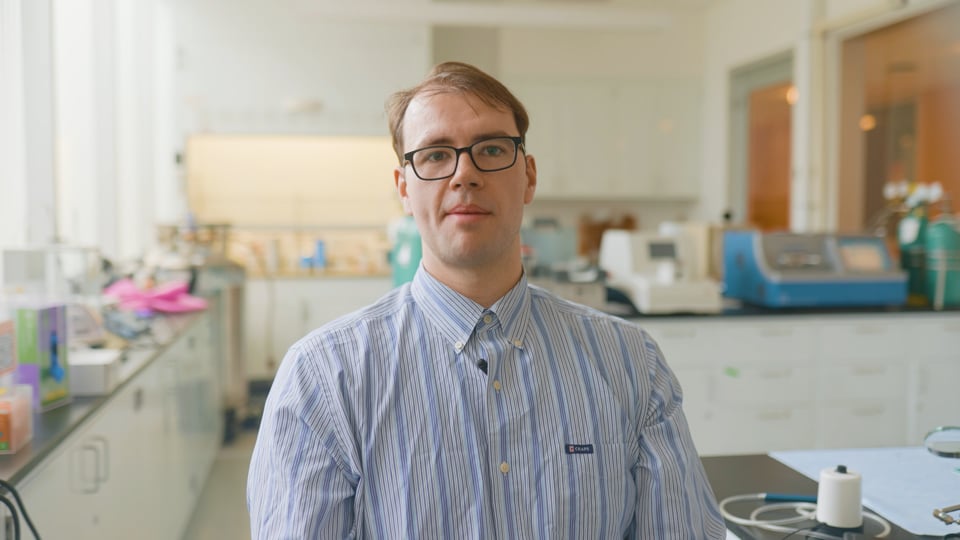
More recently, graduate student Nicholas Palmer on Dominguez’s research team used cryoEM to get a closer look at how actin elongates and shortens—something many groups had tried and failed to do before.
The scientists created artificially shortened actin filaments that would be easier for cryoEM to visualize. The images that Palmer captured enabled the team to create a movie of how actin monomers are added to the filaments. First, a helper protein called formin attaches to the actin strand. Next, the formin extends an arm to a nearby actin monomer, which itself is bound to a protein called profilin to prevent the monomer from spontaneously sticking to the strand before its time. Finally, the profilin falls away, leaving the newly attached monomer on the elongated strand.
The team published their results in Nature in 2024.They are now using cryoEM to capture images of the reverse process—how monomers get taken away when actin strands shorten.
Seeing the structures involved in biological processes is one of the best ways to understand how these molecules function as the stuff of life, structural biologists say. Whether the questions are clinical or more fundamental to all biology, researchers are making major progress using cryoEM and cryoET in pursuit of those answers—and pushing the boundaries to ask new ones.
Kixmoeller, the MD/PhD student who studied cell division, summarized the power of this approach: “Being able to visualize protein structures at such a stunning resolution, you can answer questions you don't even know how to ask before you start the process.”