
- Basic science
- Infectious disease
- Medical and scientific imaging
- Medical education and training
- Neurodegenerative diseases
Seeing the mechanisms of disease with cryoEM
Understanding how a disease starts and gets going is essential to finding therapies and treatment—and imaging with cryoEM and cryoET is shining this light of knowledge on a growing number of diseases.
Whether it is a malaria parasite invading a cell, or the misfolding of proteins in the brain in Alzheimer’s, understanding how a disease starts and gets going is essential to finding therapies and treatments.
Researchers are using cryogenic electron microscopy (cryoEM) as their visual reconnaissance to see where things go wrong. Using cryoEM and a related technique, cryo-electron tomography (cryoET), a growing number of Penn Medicine labs are making significant findings that deepen our understanding disease mechanisms through new visualizations.
Yi-Wei Chang, PhD, an assistant professor of Biochemistry and Biophysics and associate director of the Institute of Structural Biology at the Perelman School of Medicine, who originally studied in X-ray crystallography while earning his PhD, became fascinated with cryoET when a visiting scientist gave a talk about the technique.
“That talk set my life goal,” he recalled. “I said, ‘This is the way I want to do structural biology. I want to see structures in the cell while they are doing their function.’”
Chang and his team are exploring how various pathogens—viruses, bacteria, and parasites—invade the body’s cells.
One study looked at how the malaria parasite Plasmodium falciparum infects red blood cells. Malaria afflicts roughly 200 million people and kills about 600,000 people annually, according to the World Health Organization.
When P. falciparum enters the cell, it carries with it a sort of bag of tricks to help it establish infection. This bag is actually a club-shaped organelle called a rhoptry.
With cryoET, the team examined the parasite, identifying two rhoptries as well as a “rhoptry secretory apparatus” that ultimately guides the rhoptries to the “mouth” of the parasite to ready them for delivery into the host cell.
The images show that the rhoptry secretory apparatus supports a membrane vesicle under the parasite’s surface to prepare it to breach the host cell’s defenses and infect the host cell, a process has been called “parasite kissing and spitting.” Chang and his team published the study in Nature Microbiology in July 2022.
The ability to visualize the steps involved in the process, Chang said, reveals potential targets for stopping infection by malaria and related Toxoplasma and Cryptosporidiumparasites.
A closer look: How malaria parasites prepare for infection
The malaria parasite P. falciparum carries bag-like sacs called rhoptries that contain the tools needed to successfully infect human blood cells. At left, a schematic shows a parasite as it prepares to “kiss and spit” rhoptry contents into a red blood cell to initiate invasion. At right, cross-sections of 3D cryoET images of the parasite’s tip reveal a small complex structure named the rhoptry secretory apparatus (light blue) that holds a membrane vesicle (pink) under the parasite’s surface, where it guides the two rhoptries (orange) to the proper site for breaching the host cell’s defenses. Source: Yi-Wei Chang laboratory, Penn Medicine.
Rewriting the textbook on how cells take out the trash
Parasitic diseases are not the only types of diseases that researchers are learning about using cryoEM and cryoET. A team of Penn Medicine researchers led by Moiseenkova-Bell is studying what can go wrong when the cell’s recycling system fails to work properly.
This system features a fleet of membrane-enclosed sacs that carry bits of protein and other detritus to the cell’s outer membrane, where they dump them at the proverbial cellular curb.
When lysosomes don’t function properly, they can cause lysosomal storage diseases and may play a role in neurodegenerative diseases like Parkinson’s and Alzheimer’s, as well as various cancers.
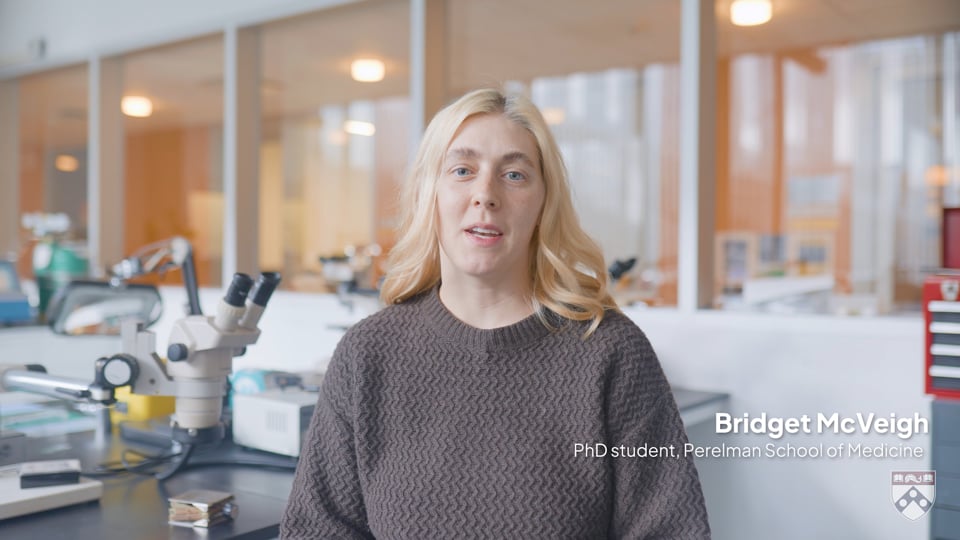
To take a closer look, pharmacology graduate student Bridget McVeigh turned to cryoET. She froze individual lysosomes and placed them in the microscope.
The resulting images provided perhaps the most detailed view yet of these organelles. Some of the lysosomes contained multiple concentric layers like the inside of a flaky cinnamon roll. Some contained fragments of proteins, and others were practically empty. Their outer surfaces were studded with three membrane-associated proteins: V-ATPase, flotillin, and clathrin. The work was published in Nature Communications in October 2025.
The study raised a number of questions. Are there various kinds of lysosomes—ones that carry different cargos, such as only lipids or only proteins—or are the lysosomes at different maturation stages? Do the surface proteins help with organizing their tasks?
One of the biggest surprises was the complexity of the structures, said McVeigh. “It’s so different in textbooks, where lysosomes are just empty and circular, versus what we're actually seeing, where they're very heterogeneous in size and content.”
Bridging lab and clinical research
As researchers expand their knowledge of disease using cryoEM and cryoET, they’re finding ways to extend the techniques beyond single particles to include cells and tissues.
For example, could these imaging techniques be applied to human brain tissues to gain insights into neurodegenerative diseases such as Alzheimer’s?
The challenge is that human tissues are too thick for electrons to penetrate.
To thin the samples, researchers recently borrowed a process from the physical sciences involving a focused beam of ions that acts like a miniature bread slicer.
Benjamin Creekmore, PhD, a Penn MD/PhD student then in his PhD training, carried samples of brain tissue donated by Alzheimer’s disease patients straight from autopsy to the lab, where he cryogenically froze the material to prevent the formation of ice crystals that can degrade the tissue. Then, with help from fellow MD/PhD student Kathryn Kixmoeller, PhD, he put the samples into the focused-ion beam milling device to create extremely thin slices of the brain tissue.
To get the cleanest slices possible, they first cut vertically into the tissue to create a smooth face from which they could then reach the sample’s interior to generate horizontal sections from deep within the sample rather than from the top. Then they imaged the sections with cryoET.
The new process they developed required close monitoring and 24-hour-long shifts in the lab, said Creekmore, who is now completing the MD portion of his studies.
“What kept me going was knowing that we were learning new things that people hadn't seen before about diseases that are really devastating for people—Alzheimer’s disease is, for a lot of people, one of the most dreaded diseases that they could get,” Creekmore said. “Working on something like that, it felt like it was making a difference.”
The resulting images revealed evidence of protein structures that are likely tangles of tau proteins, a defining feature of Alzheimer’s disease, showing that neurodegenerative diseases can be observed with cryoET at high resolution in their native environment.
The team could also see myelin, the material that insulates brain cells and becomes damaged in patients with multiple sclerosis. The research was published in Nature Communications in March 2024.
The team included Creekmore’s co-advisors Chang and Edward Lee, MD, PhD, a professor of Pathology and Laboratory Medicine and co-director of Penn’s Institute on Aging, as well as Kixmoeller’s advisers, Chang and Ben Black, PhD, a professor of Biochemistry and Biophysics and a member of the Institute of Structural Biology.
The use of cryoEM and cryoET as techniques for studying human clinical samples can have a significant impact on the study of the brain, said Lee.
“It is amazing that we can see individual molecules and how they interact with each other,” Lee said. “When you finally see something in 3D, it makes sense. It all comes together.”