
- Basic science
- Gene therapy
- Genetic conditions and rare diseases
- Medical education and training
- People of Penn Medicine
Where peak performance meets progressive disease
Hansell Stedman and his team draw on personal experience at the extremes of muscle function—world-class athleticism and muscular dystrophy—as they strive to develop a safer gene therapy for Duchenne muscular dystrophy.
Hansell Stedman, MD, knows what's happening in his leg muscles as he sprints up a snow-covered hill and skates down the other side.
As a competitive cross-country skier, he draws on decades of athletic experience. But he also understands muscle at the molecular level—the identity of the muscle fibers powering his climb, for instance, and how these fibers switch to a less efficient metabolic pathway that produces lactic acid.
By working his legs, pushing them outward in strokes like those of an ice skater, rather than gliding down the hill, he also knows he can force his muscle cells to burn that lactic acid. This strategy, while painful, can power a second wind that will give him an edge on his competitors.
Stedman, a professor of Surgery at Penn Medicine, learned this and much more over four decades of studying muscle function in Duchenne muscular dystrophy (DMD), the disease that took the lives of his two brothers.
In the late 1980s, when Stedman was a surgical resident, geneticists identified the gene that is altered in DMD and determined its sequence. The discovery opened the door to finally understanding how the disease damages and eventually destroys muscle. Stedman recognized that the goal he and others had long sought—curing DMD—might be possible.
As a skier, not just a scientist, he saw an added benefit. “There's a dividend here,” he realized, “because it’ll allow me to compete in a muscle physiology-driven sport by understanding how to focus on what matters most in training and recovery.”
Stedman has been racing for 50 years, with the goal of competing in the Masters World Cup and Winter World Masters Games “as long as there’s any natural snow left,” while pursuing what he calls the “quest for the Holy Grail,” a cure for Duchenne muscular dystrophy. He has built a lab in the Pennsylvania Muscle Institute (PMI) at the Perelman School of Medicine in which muscle research and personal experience inform each other, a dynamic reflected in the people who have joined him. They include an elite rower who looked to her athletic training to design experiments, and a Penn senior with DMD who has been both researcher and therapy recipient. Together, they are working to give dystrophic muscles more resilience—in effect, to restore to them some of the durability that protects those of an athlete.
Two discoveries
In one of his earliest memories, Stedman recalls people in white coats asking him to climb stairs, lie down, stand up. While he took these movements for granted, his older brother was struggling with them. Years later, his younger brother began showing the same difficulties.
The gene responsible wouldn’t be identified until after he had lost both brothers. But once scientists pinpointed the malfunctioning DNA, they could find the protein it was supposed to produce: dystrophin.
Dystrophin isn’t directly involved in muscle contractions. Instead, it stabilizes and protects the structure of the muscle cell. In DMD, genetic mutations interfere with dystrophin production. Without it, muscle cells become prone to rupture, causing damage that destroys them.
But well before researchers determined the molecular origins of this condition that would shape Stedman’s professional goal, Stedman had discovered what became his lifelong athletic passion. Brutal winters in Boston during his undergraduate years at MIT froze the Charles River solid and buried cars in snow. A native of Atlanta, with only limited experience with snow, he skied over both snow-covered cars and the frozen river and fell in love with the sport.
Over the decades that followed, Stedman kept skiing while pursuing a cure. He came to Penn for surgical residency in 1984, and then joined the faculty at a time when Penn was actively recruiting researchers who would define the new field of gene therapy.
Because DMD causes progressive damage to muscle, Stedman knew that a cure would mean different things to people of different ages. By correcting the body’s inability to produce dystrophin, a curative gene therapy would stop the disease’s progression or prevent it entirely in those too young to have developed symptoms.
Gene therapy can silence, replace, or alter faulty genes, making it a powerful tool for genetic disorders like DMD. In the 1990s, Stedman’s muscular dystrophy research advanced to the point where a gene therapy trial was in the works. Then, in 1999, a participant’s death in an unrelated trial for a different disease forced much of the field to hit pause.
In the years that followed, progress resumed with numerous gene therapies receiving FDA approval. But safety concerns persist.
“One of the bitter lessons is that the difference between a curative experience with gene therapy and a lethal complication is usually driven by the immune response,” Stedman said. “We are now building on generous support from the PMI, the National Institutes of Health, and a Penn startup biotech company StrongHolt Therapeutics to address these issues head on.”
A different kind of expertise
In December 2024, Yuva Gambhir, a Penn undergraduate with DMD, received an infusion of a commercially available gene therapy intended to replace dystrophin in muscles. He knew the risks, as both someone with the condition and as a researcher. Collaborating with Stedman and others, he had co-authored a perspective piece examining issues raised by the deaths of two participants in a clinical trial for a similar gene therapy developed to treat an even more severe form of muscular dystrophy.
Gambhir’s own experience with DMD motivated him to study it. In high school, his condition progressed to the point that it felt like a disability. He went from getting around on a mobility scooter, standing and even stepping on his own, to needing a power wheelchair. Keeping up with friends and staying out late became more difficult.
He wanted to learn more about DMD, so, as a rising junior in high school, he enrolled in a summer course in Stedman’s lab. He remembers the instructor, a graduate student with a milder, late-onset form of muscular dystrophy, asking students to look up life expectancy for DMD. After learning it was 26 years old, other students looked at him. “It kind of felt like being a fish in a fishbowl,” Gambhir said. “But I ended up not minding it too much, and I had a great experience."
Not only did the course teach him about his condition, Gambhir met Stedman, who became his mentor and an invaluable source of support. Gambhir returned to the lab the following summer, before enrolling at Penn as an undergraduate. As a lab member, he prepared tissue samples from mice and jellyfish—two animals the lab uses to study DMD—and examined them under the microscope.
Around that time, about six years ago, the lab was developing a promising workaround to a major challenge: In DMD, the immune system, unaccustomed to dystrophin, can see the protein as a threat, triggering dangerous reactions. The lab found that a related protein, utrophin, could slip past its defenses. Their work in the years since has focused on a potential gene therapy to help the body create utrophin to replace the dystrophin missing in DMD.
This research, and the muscle physiology he learned from Stedman, has helped Gambhir truly understand his disease and made it possible for him to evaluate potential therapies at the molecular level.
After starting at Penn, his interests shifted to finance and technology. He moved away from benchwork and declared a major in cognitive and computational science. But he has continued serving as an advocate, answering questions from graduate students in a gene therapy class and fundraising for the nonprofit CureDuchenne, for instance. (He is also developing FanCoach, an AI-powered app delivering real-time, personalized explanations of sports plays.)
For his advocacy, resilience, and persistence, Gambhir was recently named Philadelphia Citizen’s Young Citizen of the Year.
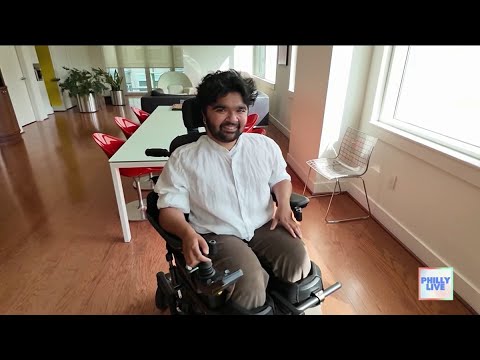
But in the meantime, however, his disease continued to progress. By December 2024, he needed a ventilator to breathe at night and for part of the day. He decided to try the dystrophin gene therapy with the hope of slowing his loss of muscle function, but knowing his prospects were uncertain.
Gambhir was lucky: He only experienced a fever and nausea from that treatment, and in the year since, his condition has remained stable—perhaps because of the therapy, perhaps not. Two other boys who received the therapy died of liver failure and the FDA has since limited access to it.
He hopes newer approaches, like the utrophin-based gene therapy still in an early stage of development in Stedman’s lab, will continue to push the field forward.
“We’ve made significant progress,” said Gambhir, now a senior who will graduate from Penn in May. “But we’re not at the finish line yet.”
Science as an endurance sport
While Gambhir brought the reality of this muscle disease into the lab, Coral Kasden, PhD, applied her experience at the other end of the spectrum—as an elite rower—to fighting it. She was a PhD student at Penn working on a different biomedical problem, the formation of blood vessel clogging plaques, when she heard Stedman present on utrophin. He described preliminary work on this strategy during a guest lecture in her gene therapy class, and she was hooked.
“With his research, it was like, we are actually treating this disease rather than untangling how it’s caused,” Kasden said. “I’d never been part of that translational approach before.”
She joined Stedman’s lab, where she is now a postdoctoral fellow. Her recent paper in Molecular Therapy brought utrophin-based gene therapy a step closer to reality by testing its effects in the heart. If utrophin protected skeletal muscles, those who received it could become more active, placing more strain on the heart. Kasden wanted to know if treatment would also help this muscular pump handle the additional stress.
To find out, she needed to push the cardiovascular system in an animal model of DMD without causing the animals’ weakened leg muscles to give way. And, like Stedman’s research has guided his training, her own athletic experience provided a guide for her research—she led the U.S. team to gold last year at the World Championships in beach sprint rowing, an event that will make its Olympic Games debut in 2028.
Specifically, Kasden drew on a phase in her training cycle when she and her teammates alternate between longer, low-intensity sessions on a rowing machine or bike and higher-intensity workouts running or rowing. She had the mice in her study run at a pace that would put them somewhere between the two, elevating their heart rates and working their leg muscles, but not too much.
Translating this strategy into a regimen for mouse-sized legs took significant trial and error. But the results were striking: Dystrophic mice treated with utrophin gene therapy ran at higher speeds for longer. What’s more, the therapy provided long-lasting protection against heart damage—“a major step” toward clinical trials, according to Stedman. He hopes to have a clinical trial launched in about a year, after additional rigorous work and careful review of the proposed trial by the FDA. To move the work beyond the laboratory, he co-founded the biotechnology company StrongHolt, named after his older brother, to help manage the manufacturing and regulatory issues for a clinical trial he hopes to see initiated within two years by colleagues at Children’s Hospital of Philadelphia.
Gambhir may have a second chance with another gene therapy, though the odds are long. For one thing, his immune system now makes antibodies against its delivery system, a consequence of the earlier treatment. But he remains hopeful, for himself and for others.
“I’m particularly interested in getting rid of DMD, so no one else has to deal with what I’ve gone through,” he said.
Kasden sees a throughline between athletics and research: endurance. While she arrived eight years ago, Stedman has been working toward a cure for nearly four decades.
“It’s like training,” Kasden said. “You just have to continue to show up.”
Volunteers needed for a study that can support DMD gene therapy research
A research team at Children’s Hospital of Philadelphia that collaborates with Hansell Stedman’s lab is seeking volunteers—both those with muscular dystrophy and healthy individuals ages 2-10—for a non-invasive study on muscle breakdown. Participants wear a sensor and provide urine samples. The findings will help researchers better understand DMD and design more efficient clinical trials.