
Transformative times, transformative leaders: An oral history of Penn Medicine’s pivotal path to prominence
Penn Medicine’s eminence today traces back to investments in the 1990s and early 2000s in people, places, and uniting in the purpose of academic medicine.
Now—this exact instant—is a remarkable moment in the history of medicine. If you talk to any adult anywhere, any person in their 20s or older, about some of the real treatments available to patients today, then much of what you’re describing—gene therapy for blindness, making tumors glow for more precise removal, and re-engineering patients’ own immune cells to cure cancer—is something that was the stuff of science fiction when they were born.
Penn Medicine—this particular institution rooted in Philadelphia as home to both the nation’s first medical school and first hospital, now united as the University of Pennsylvania Health System and Penn’s Perelman School of Medicine—is an equally remarkable place, as the modern birthplace of so many of these spectacular biomedical firsts. Penn Medicine research has substantially contributed to 45 new U.S. Food and Drug Administration approvals for new disease treatments (and counting) since 2013. Among these were the first mRNA vaccines, which quelled a global pandemic, saved millions of lives, and earned the Nobel Prize.
Why here, and what ingredients did it take to make this avalanche of recent breakthroughs? Part of the answer is seen as an almost inevitable part of the ethos of Penn Medicine today—that the institution is united in purpose across all of the functions of academic medicine. Excellence in medical education and training uplifts excellence in research, and research drives innovation in the best care for patients, all in an ongoing virtuous cycle.
Another part of the answer, though, is that this unity in excellence at Penn Medicine owes a great deal to what came just a couple of decades before.
“Penn Medicine has emerged as a preeminent academic medical system over the past several decades largely because of the foundations laid by two of our former deans, Bill Kelley and Arthur Rubenstein,” said Jonathan A. Epstein, MD, dean of the Perelman School of Medicine and executive vice president of the University of Pennsylvania for the Health System. “Their vision set the stage for breakthrough therapies that have transformed the world, and created an expectation of excellence that continuously draws the brightest medical students and research trainees to learn at Penn and go back out to make an impact everywhere.”
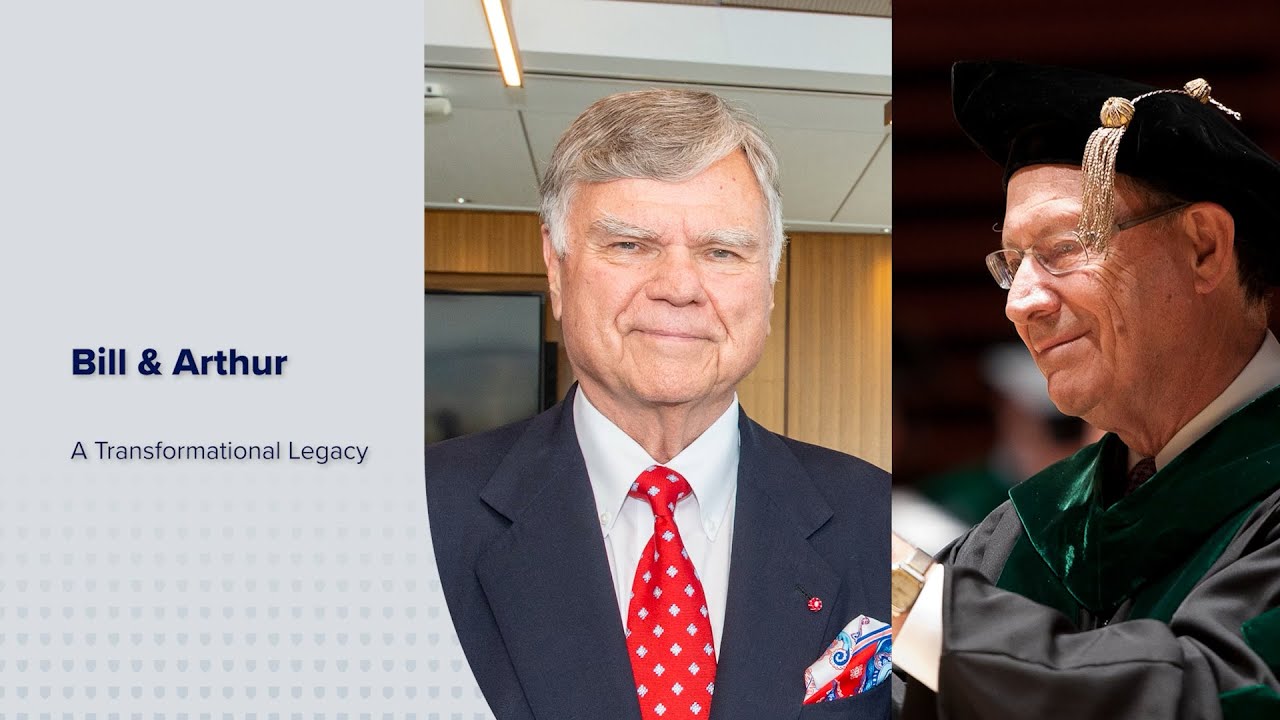
On November 12, 2025, Epstein announced the rededication and naming of Penn’s Biomedical Research Building in honor of William (Bill) N. Kelley, MD, who led the institution from 1989 to 2000, and his late wife, Lois; and the rededication and naming of Penn’s Clinical Research Building in honor of Arthur H. Rubenstein, MBBCh, who led Penn Medicine from 2001 through 2011, who shares the building name with his late wife, Dr. Denise Rubenstein. Rubenstein received an additional honor when he was named this month as the winner of the 2026 Research!America Herbert Pardes Family Award for National Leadership in Advocacy for Research. This award recognizes individuals who have demonstrated distinguished academic leadership and sustained commitment to public engagement and advocacy for research.
For those who know Penn Medicine as it is today, it may look preordained or inevitable as a place that was home to such pivotal “firsts” in American medicine even before the nation’s founding. But those who lived through the past several decades and worked with these leaders say otherwise: There were crucial choices and turning points. There were investments and opportunities seized. There was a vision and a movement among people joining together to make that vision come to life.
“Bill Kelley believed that health care could be stronger if it worked as one. That belief became the foundation of Penn Medicine as we know it today,” said Kevin B. Mahoney, CEO of the University of Pennsylvania Health System. “And Arthur Rubenstein took that foundation and gave it life; he led, but more importantly, he inspired. He reminded us that excellence is not just about science, but also about people.”
In the following oral history, longtime faculty and other leaders from across the medical landscape reflect in their own words on the transformative times from the 1990s through early 2000s, and the key leadership choices that grew Penn Medicine into the eminent institution that it is today.
Then and now: The emergence of modern molecular and translational medicine
The late 1980s were a time at the precipice of massive change in medicine when the traditional healing arts, while already modern and evidence-based, began to converge with more basic biological discoveries of the underlying mechanisms of disease. By the late 1990s, scientists knew substantially more about the biology underlying many diseases than ever before, but questions of how to apply that knowledge to create new treatments, still constituted a so-called “valley of death” that was rarely bridged. In the 1990s, Penn Medicine skyrocketed from 10th place in National Institutes of Health funding up to 2nd, it has remained in the upper echelon of competitively funded research institutions ever since. The timing mattered—when crucial decisions to invest in the leading edges of medicine helped Penn Medicine position itself at the forefront of, and ultimately as a driver of, these rapid transformations.
“We should have great basic science, but basic science in a medical center should inform research for patients. How do we cure disease? How do we make things better for patients? I always had that as the integrated dream to have basic science and clinical research in the same area where they were not separate entities.”
Glen Gaulton, PhD (vice dean for global health who previously served as chief scientific officer for 15+ years): I was in graduate school in the early 1980s, and at that point, one human gene had been isolated and described. Only one. And yet by the ‘90s, dozens and dozens of genes had been described…. then as we started to understand the molecular structure of genes and the basis of how genes control cell and organismal function, that opened up an entirely new field of medicine.
Jean Bennett, MD, PhD (pioneering gene therapy researcher in ophthalmology): It was a really early time in the field which is now known as gene therapy. We didn’t know most of the genes. We didn’t have models for the genes. We didn’t know how to deliver them or what the safety parameters were.
Michael Parmacek, MD (cardiologist, researcher, and director of the Penn Cardiovascular Institute since 2005 and chair of Medicine since 2015): Bill [Kelley] really lit the fire under Penn. Bill recognized that Penn had a rich history. It was the first school of medicine and had many, many years of achievement. But it wasn’t the institution he wanted it to be.
William N. Kelley, MD: I truly believed at that time that gene therapy in the 21st century was going to be as important as antibiotics were in the 20thcentury.
Gail Morrison, MD (nephrologist and vice dean of medical education from 1995 through 2018): [Bill Kelley] was very innovative. He was very creative. He was very visionary. He was very inspirational. He recognized when things had to change, and he did not let anything stand in his way in order to make those changes.
Gaulton: It was like somebody grabbed you by the collar and dragged you into a new era—the era of molecular medicine.
Bennett: [Dr. Kelley] realized that this was going to be a long process and wanted to invest in it. And it's because of his interest in promoting this research that there has been so much progress in treating diseases from a genetic perspective.
Gaulton: Arthur [Rubenstein]’s great strength was in advancing what is now popularly called translational science. This was built on Penn’s growing prominence in molecular biology paired with the inherent synergy of our school and health system.
Arthur H. Rubenstein, MBBCh: I never thought that we should be known primarily for our basic science. We should have great basic science, but basic science in a medical center should inform research for patients. How do we cure disease? How do we make things better for patients? I always had that as the integrated dream to have basic science and clinical research in the same area where they were not separate entities.
Francis S. Collins, MD, PhD (former director of the National Institutes of Health and former mentee of Kelley): Penn saw [a focus on molecular biology and its applications to therapies] as the sweet spot for the era that we’re [now] in the middle of. And building skills and capabilities in that space provided a magnet for trainees and other junior faculty to come and be part of that. That’s kind of the signature of Penn Medicine, in the minds of many of us: the focus on molecular biology, cell therapy, gene therapy taken from the bench to the clinic. And then what you learn at the clinic, you take back to the bench and you make it better…. [Bill Kelley and Arthur Rubenstein] building that together made this whole pipeline from basic science discovery to [now 45] FDA approvals of therapeutics, a reality. I don't know any other institution that had that kind of coherent, synergistic plan about how to advance human medicine the way that Penn did under their leadership.
Empowering the people now building the future of medicine
Science and medicine are powered by people, and built through continuous investment in future generations. A hallmark of Penn Medicine’s growth and prominence among academic medical centers over the past several decades has been the recruitment of leaders, scholars, and trainees who work together toward a bold vision and shared mission.
Among the countless outstanding faculty whose arrival at Penn set the stage for future success: Jean Bennett, MD, PhD, and Albert Maguire, MD, as well as James Wilson, MD, PhD, came to Penn to build the foundations of their landmark gene therapy breakthroughs in the early 1990s. Virginia M.-Y. Lee, PhD, MBA, together with the late John Q. Trojanowski, MD, PhD (pictured together in their lab at right), not only made foundational discoveries of their own about Alzheimer’s and other neurodegenerative diseases, but created a powerhouse center for research on aging at Penn. Carl June, MD, recruited to Penn Medicine in 1999, became the leader and center of gravity for numerous new treatments using CAR T cell therapy, and is one of many dozens of research and clinical leaders who elevated the Abramson Cancer Center to world prominence.
Victoria Mulhern (longtime leader of faculty affairs): My position gave me the opportunity to be part of the faculty recruitment and appointment process. They numbered probably around a thousand when I started [in 1996], and about 4,500 when I retired [in 2021]. So it became an absolutely booming center for discovery, across clinical areas, research areas, and also in innovative teaching areas.
Bennett: [Bill Kelley] attracted a very large number of talented people who had the same really incredible, dazzling ambitions to try to develop treatments which would stop a disease at its root, i.e. the genetic basis of the disease. There really was no precedent for this. This was way out there and almost science fiction-y. But he believed that this was possible and allowed people like me, and many others, to try it out.
Parmacek: It’s the resilience. It’s the vision. It’s the boldness in their vision. And that’s what the two of them were exceptionally good at recognizing in people.
Gaulton: Arthur tended to recruit individuals who were more collegial, and individuals that could weave the fabric of what we did together, which was a reflection of his vision for the entire institution.
Rubenstein: I always wanted to say we could be the best there was, and that was irrespective of me. It was just that I recognized [the best people to recruit]. And so when they came, there was no credit to me; the credit was all theirs. But they felt part of this culture we created and most of them thrived in that kind of atmosphere. Everybody felt they could contribute to the best of their ability, and most of them did. And that made the place, which was very good—that made it really great.
Morrison: For those of us that came into medicine in the 1970s, nobody could ever have dreamt about doing some of the things that we are now doing related to genes, to CRISPR, to CAR T, to mRNA vaccines… None of this would have happened without [Kelley and Rubenstein both] bringing in the kinds of people they brought in. And they stood by things even when people told them it wasn’t going to be successful.
Bennett: It took 17 years from the point where we had proof of concept in an animal model in the laboratory, [until we showed] that we could actually reverse blindness in children and adults with an inherited form of blindness. Then it encouraged other groups to take off. And now there are more than half a dozen FDA-approved treatments for different genetic diseases.
United across purpose from education to research to health care
Penn Medicine invested earlier, and to a greater degree than other medical schools in its peer set, in establishing and sustaining true integration as a system.
Integration has been built into the structure of the institution since Kelley’s arrival as the first leader to oversee both the medical school and health care enterprise at Penn. In 1993, he proposed a new structure and founded the University of Pennsylvania Health System as one of the first fully integrated academic health systems. The Health System later experienced significant financial challenges in the late 1990s, and upon his arrival, Rubenstein was instrumental in preserving an integrated structure and sustaining the hospitals’ connection to the university and medical school—a crucial moment to help Penn Medicine stay the course toward today’s greatness.
While more recent global headlines laud research breakthroughs and new treatments for patients at Penn, education has consistently served as the foundation of this connected system. In the 1990s, Morrison led the development of Curriculum 2000, a medical education framework that emphasized lifelong learning, that gave students space for “MD plus” pursuits including dual degrees. Meanwhile, Penn’s biomedical PhD training program grew from one widely recognized as good quality, to one of the world’s preeminent graduate training programs in biomedical sciences, while the combined MD-PhD program grew to become the world’s largest of its kind.
The connections between students and trainees with world-class clinicians and researchers signified a major uniting force for Penn Medicine—in which strengths across three mission areas continuously uplifted one another. And this integration extends to Penn Medicine’s other disciplinary realms across the university, from veterinary and dental medicine to business and engineering.
“The first mission of any academic medical institution is to educate and train the next generation of leaders in medicine and science.”
Rubenstein: [My father, a Jewish refugee,] landed up in South Africa before the First World War, speaking only Polish. His mother had died in a pogrom in Warsaw. He wanted to be a doctor, but he didn’t have the money or the language ability to do that. So he became a pharmacist because he could work at night and learn English during the day. He was a great role model for me because I saw what hard work and commitment looked like, and he really believed in education.
Kelley: Our mission was to promote, simultaneously, the three pillars of the academic health system: education, research, and patient care…. [I always list them] in that order, recognizing that the first mission of any academic medical institution is to educate and train the next generation of leaders in medicine and science.
Morrison: Having basic researchers come into the school and show students what they're doing and why they're doing it, and how really exciting it is, was critical [among Curriculum 2000 innovations]. The same thing goes for clinicians… [Now] everybody has some role in the School of Medicine teaching, even if you are a clinician full-time or a researcher full-time. And that's why having the Penn Medicine integrated system was so critical.
Parmacek: Bill and Arthur really understood that what made Penn special was the integration of science with medicine, with education. And it was the sum of those three different missions that really distinguished Penn Medicine from other top-tier organizations.
Kelley: I often used the phrase, “You cannot educate and train students, residents, and fellows on empty beds,” nor can you effectively conduct clinical research. That understanding was the rationale for the Health System.
Rubenstein: How do you integrate the missions of a complex organization so that they enhance each other? Education, clinical patient care, basic science, and clinical research, those four modalities in many, many places, they are very separate or they only interplay a little bit. But I had the belief that if we could integrate them really fully, that would make each of them uniquely better. And that was a dream I had [since I was a medical student]. And when I came to Penn, I thought there was a chance to do that. It wasn’t obvious we could do it, but there was a chance we could do it.
Kathryn Griffo (Penn vice president for Development and Alumni Relations, formerly chief advancement officer for Penn Medicine): That ambitious goal of integrating research, education, and patient care missions attracted many donors who had a new opportunity to make a gift that was truly meaningful and impactful to them. Our donors and alumni felt engaged as partners in shaping Penn Medicine’s future.
Rubenstein: Ralph Muller’s role [as CEO of the Health System from 2002 to 2019] was really, really important, and our partnership was very special. He had the same vision as I had in terms of what made a health system, with science and education together with great clinical care. We gradually put the finances back in order, and then after that the health system thrived, and we were able to send all the money back to the university that they had loaned, with interest, and we were happy to do that because we were a great part of a great university.
Bennett: I think one of the most amazing aspects of Penn Medicine is that there is so much talent here that it's really easy to find collaborators in different fields, and even working with people in the law school or the dental school or the vet school.
Rubenstein: I wanted us to be an integral part of the university where both the university would be proud of us, and we would contribute in a positive way, not just financially, but more intellectually and as a partner. And the two university presidents who I worked under, President [Judith] Rodin and President [Amy] Gutmann, they believed in that implicitly.
Gaulton: Arthur’s legacy is a baseline expectation that we’re all together in this and that we work seamlessly between the academic and the clinical side. It’s something that we now all take for granted. His legacy is the cohesiveness of our institution, which is a fundamental property and identity of Penn Medicine.
Rubenstein: We had very strong basic science which Bill Kelley was a leader in recruiting. But I took that basic science, which was excellent, and tried to focus it on patient care, and disease-oriented research. Things like CAR T cells, David Fajgenbaum’s work on Castleman’s disease. These have all come out of science related to patients and patients’ diseases, and that’s what I think a medical center can do as opposed to a research institute. We developed institutes to take advantage of that: We already had the great Abramson Cancer Center, and then the Institute for Diabetes, Obesity, and Metabolism, the Institute for Translational Medicine and Therapeutics (ITMAT), and the Cardiovascular Institute, they were integrated as an expression of that goal, connecting basic science to treating disease. And that’s what I think we have become known for.
Collins: When I was NIH director, for 12 years, I could look around and see which of the institutions that are really just focused on themselves, and which are the ones that are really interested in being part of a network [and learning collaboratively with peers across the country]. The way that Garret FitzGerald managed ITMAT was a golden example of how to take that resource and turn it into a leader on the national scene. All of the other [NIH-funded] clinical [translational research] centers linked up and many of them [are] learning things from Penn, because Penn really had thought about how to do the boldest and the most significant clinical research.
The power of place in elevating medical greatness
The Clinical Research Building, which will soon bear the names of Arthur and Denise Rubenstein, was completed in 1989, the year of Kelley’s arrival at Penn. Kelley saw a need for significantly more research space to continue attracting future leaders in molecular medicine. The Stellar-Chance building (initially named Biomedical Research Building I) opened in 1994, followed by the Biomedical Research Building II/III, now rededicated in Bill and Lois Kelley’s honor, in 1999.
But these research buildings were only the first of what became much more massive changes to Penn’s medical campus—and the impacts of these architectural choices were part and parcel of the larger story of the campus’s deeply integrated missions.
In 2008, the first of what is now a massive array of new buildings opened at the former site of the Philadelphia Civic Center: The Perelman Center for Advanced Medicine (PCAM) was not only a state-of-the-art outpatient center, replacing an old, repurposed building called Penn Tower (a former Hilton Hotel). It was the philanthropically supported foundation of a larger complex including the Roberts Proton Therapy Center, the Smilow Center for Translational Research, and a 2015 south tower expansion of PCAM that included the Jordan Medical Education Center. Adjacent, today, stands The Clifton Center for Medical Breakthroughs, where Penn Medicine delivers some of the world’s most advanced inpatient care.
These spaces where scientists, clinicians, and students interact were equally as much a magical ingredient in Penn Medicine’s growth in recent decades, and in the power of research, patient care, and education working together in one place.
“This campus is such a powerful symbol of the Penn Medicine approach—and it also represents the partnerships across faculty, health care teams and researchers, students and trainees, and the donor and alumni community who are transforming that symbol into world-class medicine.”
Kelley: Resources in the form of first-rate educational, research, and clinical space and facilities were required to attract those [world-leading] teachers, scientists, and physicians to Penn. It took a total team effort to achieve this.
Griffo: Bringing new life and excitement to our historic campus attracted outstanding faculty and a growing forward-thinking community interested in supporting their work—Leonard and the late Madlyn Abramson’s landmark gift to create the Abramson Family Cancer Research Institute immediately comes to mind. Arthur’s vision and commitment to translational medicine then changed how our philanthropic partners thought about biomedical research. You could begin to see tremendous possibility and power at the intersections of our missions.
Gaulton: Under Arthur’s leadership, the literal foundations, the structural facilities that were created to support translational science, were laid during his time. And the best examples are what we see now on Civic Center Boulevard.
Rubenstein: The first thing I wanted to do was build an outpatient building. I think the Rhoads building, which was an inpatient building, was the last one built, which was great for inpatients. But outpatients were being done in the Hilton Hotel relic, and scattered throughout different floors of HUP. And I always believed that the heart of patient care was a beautiful outpatient building.
Griffo: Our donors appreciated and wanted to be part of this comprehensive vision taking shape, starting with the Ruth and Raymond Perelman Center for Advanced Medicine, Roberts Proton Therapy Center, and their many programs.
Rubenstein: Then they wanted to build an education building further down Convention Ave. And I said, no, no, no, no, we can't do that. We have to have it right in the middle of research and patient care. And so then we raised money from Barrie Jordan, and Ralph Muller and [now Health System CEO, then executive vice president] Kevin Mahoney and I worked out, we’d put it right in the middle of everything. And then I thought: This is my dream, patient care, research, and education all together. What could be more great?
Griffo: The power of Penn Medicine’s integrated missions set the stage for the connectedness of our growing campus, from the Henry A. Jordan, M’62 Medical Education Center to the Smilow Center for Translational Research and capped by The Clifton Center for Medical Breakthroughs. Donors and alumni were excited by this historic moment to help build and sustain everything Penn Medicine could become.
Parmacek: If you look up and down University Avenue now, you really see one of the major academic medical centers in the country with world-class facilities that really weren’t here 20 years ago.
Rubenstein: We were also working alongside the greatest children’s hospital in the country, Children’s Hospital of Philadelphia. It was important to me that we work to integrate ourselves, and now Penn and CHOP are not just neighbors, but powerhouses around the country in so many shared discoveries and impacts.
Griffo: This campus is such a powerful symbol of the Penn Medicine approach—and it also represents the partnerships across faculty, health care teams and researchers, students and trainees, and the donor and alumni community who are transforming that symbol into world-class medicine.
Rubenstein: It doesn’t often happen that you can expedite your vision, but having all the young people run around next to research and patients in the same building where doctors didn't have to go too far to do [research and care for patients], and then we added The Clifton Center. It was unique. We were able to do that because of the great university presidents we had, both Judith Rodin and Amy Gutmann, and also the structure that Bill Kelley had set up, which I give him enormous credit for, in which the EVP was head of the health system as well as research and education. Most places aren’t like that, bringing everyone together by design.
The culture of innovation, collaboration, and worldwide impact
The people, the places, and the connectedness of purpose across Penn Medicine’s missions: Together, these principles represent a major foundation of why Penn Medicine has been the home to such profound benefits to the world through lifesaving discoveries. Penn Medicine today also embraces a fourth interconnected mission area, which is to improve the health and well-being of the communities we serve. But in the continued pursuit of making the world a better place, there is one more key element in how Penn has sustained its place at the forefront. That is a culture of collaboration and a shared belief in that purpose among the people whose work continues, day after day.
Mulhern: My whole tenure here at Penn Medicine, there was an electricity in the air. You can even tell who works for Penn Medicine. When you go over to the medical center, you’ll see who’s walking the fastest, because those are the people working for Penn Medicine.
Gaulton: Many of the faculty who are here now, weren’t here under either Dr. Kelley or Dr. Rubenstein. And yet they’re benefitting from the legacy that Bill and Arthur set in terms of highest quality care matched with highest quality research—all of that underpinned by the expectation that we should continually expect more of ourselves to generate an exceptional institution producing meaningful impact.
Rubenstein: What I’ve always tried to do, going back to my days at the University of Chicago and even in South Africa, I’ve tried to build a culture of support, kindness, and respect for people of all levels in the organization. Whether it's the cleaning staff or the students, faculty, administrators and board of trustees, I always try to create an atmosphere where everybody could feel comfortable and thrive.
Gaulton: It’s wrong to think about Arthur just as a healer, which I think is how most people see him. He was an incredible strategist…. Yes, he brought us together as individuals, but from a strategic perspective he catapulted the institution into the world leader of translational science.
Griffo: Arthur’s talent as a leader—and especially his character, as a human being—helped grow this singular, remarkable Penn Medicine culture that everyone could feel was different and special. It’s inspiring and creates so much hope, and I think it’s why Penn Medicine has the longevity and breadth of the donor and alumni relationships we enjoy today. It’s why [the late] Ruth and Ray Perelman chose to grow their support of our institution over the years, culminating in the extraordinarily generous act of naming the Perelman School of Medicine. Our donors and alumni are proud to be part of a positive force for the health of the world.
Rubenstein: Collaboration brings out the best in everyone, in my opinion. Whether it was between clinicians and scientists, students and faculty, the administrative staff, nurses and doctors, collaboration makes an institution great. We were able to create that culture where that was rewarded.
Collins: It’s always hard to say exactly what factors play out in achievements that lead to massive scientific advances, because people are always standing on the shoulders of others. But when you look at, for instance, what’s happened with CAR T cells, the way in which Carl June’s leadership in that space has created a whole field of cancer research and cancer clinical practice that has now saved countless lives, that’s a Penn contribution for the ages. And, of course, right there at Penn, the development over 25 years of hard work on the mRNA approach to vaccines, which we believe saved something in the neighborhood of 3.1 million lives in the United States alone from COVID-19 and maybe 14 or 20 million worldwide…. [That work led to] Nobel Prizes, well-deserved for [Katalin] Karikó and [Drew] Weissman,and something that I think history will look back on as potentially the most significant example of scientific contributions to humanity and to humanity’s survival.
Rubenstein: And here we are in Philadelphia with, I would say, one of the greatest medical systems and universities in the world. It’s pretty quick and pretty amazing. I’m pretty proud of all that.
About the interviewees
William N. Kelley received his medical degree from Emory University. Following Internal Medicine training at the University of Texas Southwestern Medical School and Parkland Memorial Hospital, he joined the staff of the National Institutes of Health and completed additional clinical training at the Massachusetts General Hospital.
In 1968, Kelley joined the Duke University faculty where he became Professor of Medicine, Associate Professor of Biochemistry, and Chief of the Division of Rheumatic and Genetic Diseases. From 1975 to 1989, Kelley was the John G. Searle Professor and Chair of the Department of Internal Medicine and Professor of Biological Chemistry at the University of Michigan. There, Kelley and his colleagues were the first to provide proof-of-concept for in vivo gene therapy as it is recognized today. His patent reflecting the work, “Viral-Mediated Gene Transfer System,” submitted in 1987, was issued in 1997.
From 1989 to 2000, Kelley served as Executive Vice President of the University of Pennsylvania with responsibilities as CEO for the Medical Center, Dean of the School of Medicine, and the Robert G. Dunlop Professor of Medicine. His strategic planning process culminated in the establishment in 1993 of the University of Pennsylvania Health System (UPHS), the nation’s first fully integrated university-based academic health system, a prototype for the organization of health care as it has evolved for over three decades. He was appointed CEO of UPHS, while maintaining his other academic responsibilities. Over the decade of the nineties, UPHS increased gross revenues from approximately $600 million to $2.2 billion and ambulatory visits from 550,000 to more than 2.5 million per year.
During Kelley’s tenure, funding for the medical school grew the fastest in absolute dollars of any U.S. medical school, moving it from #10 to #2 in NIH funding, and contributed to the school’s rise in other national reputation rankings. During the same time, Kelley established gene therapy as a major research initiative at Penn. He also created the team that led to the establishment of Curriculum 2000 ® and Virtual Curriculum 2000 ®, important new approaches to medical education.
Kelley’s bibliography includes over 300 publications and 17 books. His national leadership positions included President of the American Federation for Medical Research, American Society for Clinical Investigation, and American College of Rheumatology. Kelley’s selected honors include election to the National Academy of Medicine, American Academy of Arts and Sciences, and American Philosophical Society. He received the John Phillips Memorial Award from the American College of Physicians, the Robert H. Williams Distinguished Chair of Medicine Award from the Association of Professors of Medicine, the Gold Medal from the American College of Rheumatology, the David E. Rogers Award from the Association of American Medical Colleges, and the George M. Kober Medal from the Association of American Physicians.
Kelley is currently Emeritus Professor of Medicine at Penn. He married his late wife, Lois, in 1959 and together they had three daughters, one son, and nine grandchildren. Kelley recently became a great grandfather. He and Lana Valenta have been partners for the past eight years.
Note: Some quotes from Kelley in the article above come from a 2019 interview by Marquis.
Arthur H. Rubenstein is Professor of Medicine in the Division of Endocrinology, Diabetes, and Metabolism at the Raymond and Ruth Perelman School of Medicine at the University of Pennsylvania. Previously, Rubenstein was the Executive Vice President of the University of Pennsylvania for the Health System and Dean of the Raymond and Ruth Perelman School of Medicine from September 2001 to July 2011.
Before joining Penn, Rubenstein served for four years as Dean of Mount Sinai School of Medicine and as the Gustave L. Levy Distinguished Professor. Earlier, he was the Lowell T. Coggeshall Distinguished Service Professor of Medical Sciences and Chairman of the Department of Medicine at the University of Chicago Pritzker School of Medicine.
Rubenstein is an internationally prominent endocrinologist recognized for his clinical expertise and groundbreaking research in diabetes. Well known for his inspired teaching, Rubenstein has served in numerous professional leadership positions during his career.
Author of more than 350 publications, Rubenstein is the recipient of many awards and prizes, including the highest honor of the Association of American Physicians, the George M. Kober Medal, and the highest honor from the Association of Professors of Medicine, the Robert H. Williams Distinguished Chair of Medicine Award. Among his other honors are the John Phillips Memorial Award from the American College of Physicians; the Banting Medal from the American Diabetes Association; and the David Rumbough Scientific Award from the Juvenile Diabetes Association. In 2009, Rubenstein was awarded the prestigious Abraham Flexner Award for Distinguished Service to Medical Education from the Association of American Medical Colleges. He was elected to membership in the National Academy of Medicine in 1987.
Born in South Africa, Rubenstein received his medical degree from the University of the Witwatersrand, Johannesburg. In 2001, he was honored by his alma mater when an honorary degree, Doctor of Science in Medicine, was conferred upon him.
Rubenstein married his late wife, Denise, who was also a physician in South Africa, in 1962 and together they have two sons and six grandchildren. They all now live close to each other in Englewood, NJ, and New York City.
Jean Bennett is the F.M. Kirby Professor of Ophthalmology in the Perelman School of Medicine, retired since 2023. She and her research partner and husband Albert Maguire, MD, were recruited to the Penn faculty in 1990 to advance their vision of a gene therapy for blindness. Their work over four decades culminated in the first FDA-approved gene therapy for an inherited disease, in 2017.
Francis S. Collins is an internationally renowned genetics researcher who was director of the National Institutes of Health from 2009 to 2021, serving under three U.S. presidents. In the 1990s to early 2000s, he led the Human Genome Project as director of the National Human Genome Research Institute of the NIH. At the start of his career, after his postdoctoral studies, Collins was first hired by Kelley at the University of Michigan as an assistant professor in 1984, where Kelley was his department chair in Medicine. In that position, Collins first discovered the gene for cystic fibrosis.
Glen Gaulton is vice dean and director for the Center for Global Health at the Perelman School of Medicine and a professor of Pathology and Laboratory Medicine. A member of the Penn faculty since 1985, Gaulton has served in numerous leadership positions. During Kelley’s time as dean, Gaulton oversaw and grew the school’s combined degree and physician-scholar programs, and later was appointed to oversee biomedical graduate studies, then to lead the school’s scientific enterprise as vice dean for research and research training. During Rubenstein’s tenure as dean, Gaulton remained in the latter position as it shifted to become the school’s chief science officer and executive vice dean, a position he held until 2015.
Kathryn (Kate) Griffo is the vice president for Development and Alumni Relations at the University of Pennsylvania. Prior to assuming this role in April 2025, she worked for more than two decades as part of the Penn Medicine Development and Alumni Relations team, most recently leading the team as chief advancement officer.
Gail Morrison is the William Maul Measey President’s Distinguished Professor in Medical Education Emeritus at the Perelman School of Medicine. A member of the Penn faculty since 1976, she developed the first dialysis program at the institution, then went on to lead the medical school’s curriculum development. She became vice dean for medical education in 1995, a role she held for 23 years.
Victoria Mulhern retired from Penn Medicine in 2021 as director of faculty affairs and professional development in the Perelman School of Medicine. She worked at the school twice in her career. Initially, she was hired in the 1980s by Dean Edward Stemmler to start the school’s benefit office. She was recruited by Kelley to return in 1996 for the role in faculty affairs that she held until her retirement, after continuing to work closely in that role with Rubenstein and J. Larry Jameson, MD, PhD, now Penn president.
Michael Parmacek is the Frank Wister Thomas Professor of Medicine and chair of the Department of Medicine at the Perelman School of Medicine. Parmacek was recruited to Penn as chief of Cardiovascular Medicine during Kelley’s time as dean in 1998, and held that role until his current appointment as chair of Medicine in 2014. In 2005, under Rubenstein, he became the founding director of the Penn Cardiovascular Institute. Earlier in his career, as a trainee and as a faculty member at the University of Michigan, he worked under Kelley as department chair. In 1992, he moved to the University of Chicago, where Rubenstein was his department chair in the Department of Medicine.