
The small, high-tech beanie protecting premature babies
The Sonura Beanie, designed by former Penn Engineering students, is calming babies in HUP’s intensive care nursery.
Tiny ears need extra protection...and extra TLC. Premature babies often spend their first days in a hospital’s neonatal intensive care unit, full of breathing machines beeping, pages coming over the loudspeaker, doors opening and closing, and other bothersome noises. It’s a far cry from the cozy, muffled environment of the uterus, which keeps full-term babies from too-loud sounds.
Without the protection of the uterine lining, babies whose brains and bodies are weeks from developing to the level of a full-term newborn, are exposed to sounds that are medically too loud. Beeps and alarms alone in the hospital measure at roughly 2,000 Hertz; that’s four times the level of noise fetuses in the womb hear (500 Hertz), according to the American Academy of Pediatrics. Ventilators can emit sounds up to 8,000 Hertz. And while some outside noises are muffled for babies in incubators, others, like CPAP machines and other devices inside the incubator, are magnified.
This noise, and the stress it directly induces, can cause a host of problems for preemies: Their heart rates are higher, they sleep poorly, they don’t eat as much, and they have higher rates of language delays.
How to solve this pervasive and persistent problem? Enter a small but high-tech beanie.
Developing a safe sound device
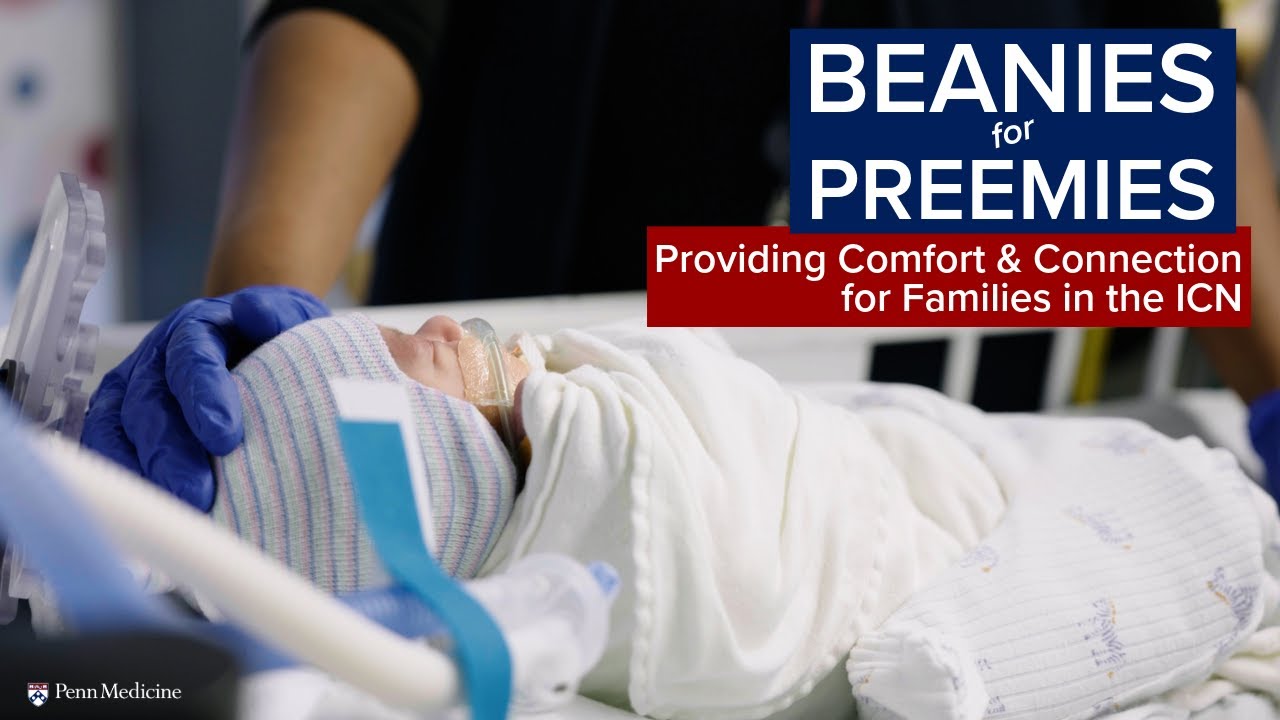
Sophie Ishiwari and Gabby Daltoso, two 2025 graduates of Penn Engineering, created a hat for premature babies which blocks out high-frequency sounds and can also play messages from their parents. They named the device the Sonura Beanie, with “sonura” coming from the Latin word for sound. Any audio the beanie plays goes through an audio filter that blocks high frequencies, which brings it under the 500-Hertz threshold, in line with what babies can safely hear. For their innovative idea, field-tested at the Hospital of the University of Pennsylvania (HUP), the two earned the President’s Innovation Prize from University of Pennsylvania President.
“Gabby and I spent a lot of time shadowing and talking to nurses, clinicians, and staff in the Intensive Care Nursery at HUP as well as parents to develop something that could make a true difference,” said Ishiwari. “We received input from hundreds of people.”
“What stuck out to us was the fragility of these babies and the moms, dads, and care providers all striving to bring the babies to a healthy place,” said Daltoso. “We wanted to help.”
Ishiwari and Daltoso took a sound-engineering class to master the creation of a device that filters out loud and intrusive sounds. They then designed a beanie with super-soft speakers sewed inside ear flaps. The beanie connects to an app to play the mothers’ heartbeat and recorded audio (parents singing lullabies, reading stories, etc.) and to adjust the level of sound the baby hears; as the baby ages and develops to the level of a full-term infant, the frequency played can be raised to resemble more common sound levels outside the womb. The beanie itself is also adjustable to fit small but growing heads and accommodates wires and tubes used for breathing and feeding, which was very important to intensive care nursery nurses.
“We’ve been told jokingly that the beanie is so soft and cozy that we should make adult versions,” said Ishiwari.
The clinical trial of 30 premature infant participants at HUP began in November 2025. It will confirm the beanie is suitable for clinical settings and will measure babies’ heart rates, and other markers of stress while wearing the beanie versus not wearing the beanie. Babies wear the beanies three times per day while they eat. Ishiwari, Daltoso, and the research team believe they will be able to complete the study and start analyzing results this April.
Following the trial, the team will focus on securing its next round of funding. From here, the group aims to do a multi-site trial of the device to see if regular use during feeding times, when babies need to be calm, will help them grow faster—the most important job for any premature baby.
A true Penn solution
From being developed by Penn students, to support of the President’s Engagement Prize, to being studied and refined at the HUP ICN, the Sonura beanie represents what can happen when smart people across the institution team up.
Ishiwari and Daltoso tapped Wendy A. Henderson, PhD, CRNP, the Gail and Ralph Reynolds President’s Distinguished Professor at Penn Nursing, to design and lead the clinical trial currently underway at the HUP ICN. Other Penn leaders joined to refine and the study and get to work including Lori Christ, MD, the medical director of the Intensive Care Nursery at HUP, Jessica Lazzeri DNP, RN, the clinical director of Women’s Health and Neonatal Nursing at HUP, and Rosemary Polomano, PhD, RN, a professor of Pain Practice in at Penn Nursing and a nurse scientist at HUP.
“The synergy of innovation, talent, and collaboration makes Penn an optimal environment for translating technological advancements into practice,” said Henderson.
“When Gabby and Sophie approached us about this project, we were immediately intrigued,” said Michelle Ferrant, DNP, RN, CNS, a clinical nurse specialist at the HUP ICN.
For years, her team, like other ICNs across Penn Medicine, had been aware of the risks of loud noises to developing babies and committed to cutting down the noise in the ICN. The nurses and nurse managers trained staff and visitors to speak quietly and close doors and lids softly. They turned down alarms to audible but lower levels and posted signs around the ICN urging people to keep noise down. It helped, but it didn’t eliminate the problem, and babies were still not calm enough during feeding times.
“We had open dialogue with Gabby and Sophie from day one, and not only did they bring their own ideas and solutions, but they were very receptive to feedback and ideas from our team,” said Ferrant. “That discourse and work up front meant that, when we got the finished product from them to try out, it was ideal.”
“As a nurse, you’re immediately skeptical of anything that disrupts the status quo of the ICN and that affects the care of these little babies,” said Kyndall Hawkins, BSN, RN, a clinical nurse in the HUP ICN, who has helped fit the beanie on one of the baby study participants. “But, after watching a fussy baby instantly calm down when hearing his mom’s voice played over the beanie, I was quickly won over.
A family’s love
Pamela Collins, her husband Franklin, and their 15-year-old daughter, Rihanna, sat in a circle in their living room at their family home in the Poconos. The Collins family turned the lights down, prayed, and pulled out a cell phone, thinking about what they wanted to say to the family’s newest member and “little miracle,” baby John. He was born at 29 weeks, and he was one of the first babies to trial the beanie.
“It’s hard not being able to be with him constantly while he’s in the hospital,” said Pamela, who’s longing to take her son home. “My husband has to work, we have our daughter to care for, too, and we’re going back and forth from our home in the Poconos to Philly to be with John. It’s far from home, but Penn was the best place for him to get the care he needs.”
As a family, the Collinses took turns recording messages on the phone to be played over the Sonura beanie for John. Pamela sang him a song in her first language, Portuguese, saying he is loved and special, one of the same songs she sang to him when he was in her womb. Franklin made up a fun story with baby John as the protagonist. And Rihanna told John she loved him, that she was excited to bring him home, and that he is “enough.”
One surprising joy from the project for Ishiwari and Daltoso has been hearing messages like these which parents and families record for their babies.
“I’ve been by myself listening to recordings of moms, dads, and relatives, who have been through extreme stress and worry, expressing so much love in their messages,” said Ishiwari. “It has made Gabby and me cry.”
“The beanie allows families to put energy and love into their messages at a particularly scary and unsure time, and I think that is helpful in its own way,” said Daltoso.
On one morning in December, a nurse placed baby John’s beanie on his head. Collins had an appointment and was not at his bedside yet that day. But, nearby with simply a tablet and the beanie communicating wirelessly, John heard his mother’s voice singing to him. He quieted down and his heart rate lowered to a healthy resting rate. He smiled and giggled. After a few minutes, he made some fussing noises and then quieted again.
“He probably went to the bathroom,” said one of the nurses nearby, chuckling. “That happens a lot. The beanie makes them relax.”
What’s next?
Ishiwari and Daltoso are working with the U.S. Food and Drug Administration (FDA) to go through the proper steps so the beanie, deemed a medical device, can be evaluated and approved to be sold. Because the device is considered low-risk, the FDA has agreed to fast-track the evaluation and approval process. The pair hopes to receive approval in the next 12 months so that hospitals around the country can use them.
Until the results from the current trial are ready, there is glowing support for the beanie from experts and parents.
“I love talking about the beanie because it is a blessing,” said Pamela Collins, who has spoken about her appreciation for it, and for Ishiwari, Daltoso, and the HUP ICN nurses, with news outlets including the Philadelphia Inquirer, 6ABC and CBS News Philadelphia. She has asked to be kept up-to-date with the FDA approval process.
“The beanie allows me to still be John’s mom even when I can’t be by his side,” Pamela said. Every hospital and every mother and baby needs them.”