
The ‘angel’ in the inbox
Patients think they’re reaching an institution when they message Penn Medicine on social media. What they remember is the person who reached back.
A year after Jimmy Iturrino’s brain bleed, when he could finally see clearly enough to use his phone, he replied to one of Penn Medicine’s Instagram stories with a message of gratitude. To him, the Penn Medicine staff were his angels, without whom he wouldn’t be alive.
It was late 2021, and Iturrino was still early in his recovery. His peripheral vision was black, and his short-term memory was so weak, he depended on written reminders from his wife for simple tasks. But he wanted to express his thanks to the health system—not only for saving his life, but for the whole patient experience.
Iturrino doesn’t remember exactly what he wrote; something like “Angels exist here," and "Penn Med saved my life.” (“They're the best," he recently said of the staff, "from the people in the parking garage that help you park when you get there, all the way to the top in the exam room.”)
His replies became a regular thing.
On Instagram, when you respond to a “story,” it sends a private message to the account rather than appearing as a public comment. Having worked in digital marketing, Iturrino assumed his messages were going to a team of staff.
In time, he would learn, there was one person. And she was ready to listen.
The supportive side of customer support
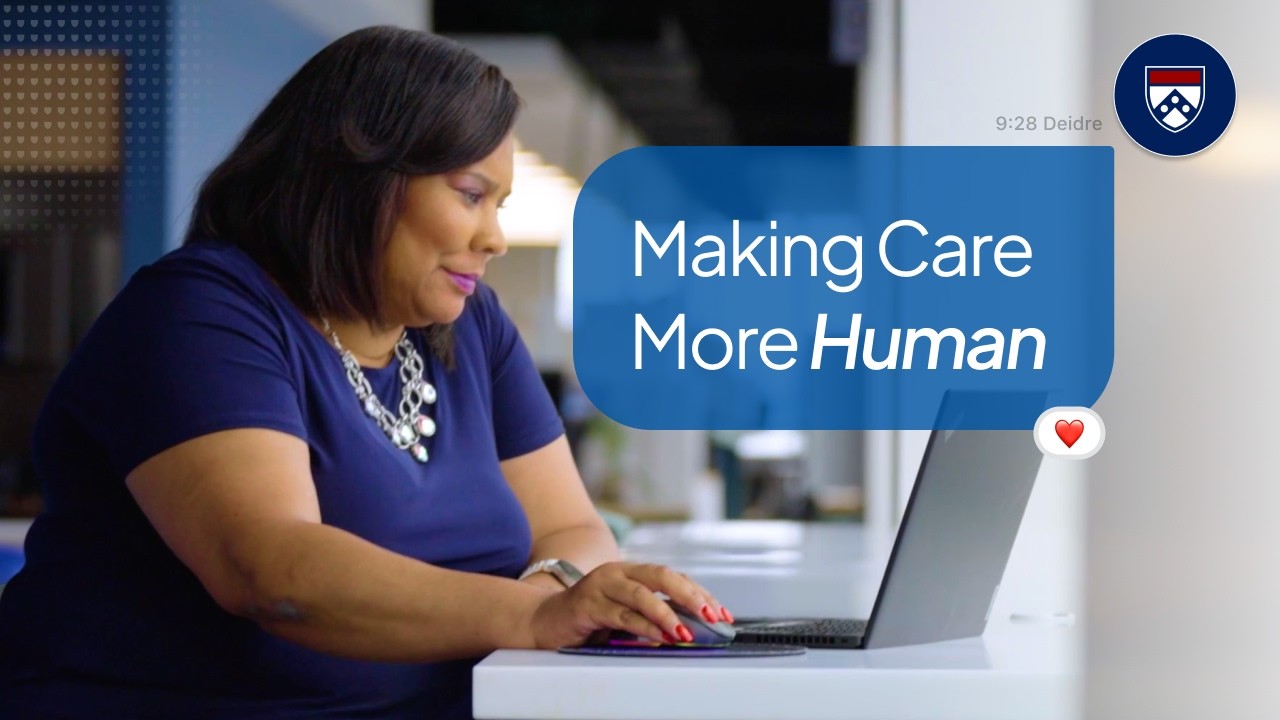
Deidre Gray, MS, senior digital communications and support coordinator, was the first full-time employee hired by Penn Medicine to answer messages on social media. She responds to questions, concerns, and comments across Penn Medicine's flagship accounts on Facebook, Instagram, YouTube, X, and Threads.
Gray answers 30 to 80 comments and private messages each day; many more get a heart or thumbs up. There are questions about surgeries and hospital logistics, complaints about seemingly minor but frustrating experiences, and urgent pleas from patients.
On any given day, the queries might look like this: Does Penn Medicine have any orthopedic surgeons who perform knee replacements for patients with morbid obesity? How can I become a cupcake vendor at the Hospital of the University of Pennsylvania (HUP)? I was turned away for an appointment after arriving five minutes late. I need to be seen urgently for a rare disease but don’t have a physician who can submit a referral.
Many people who write to Penn Medicine on social media are not having their best day. While Gray can’t replace a clinician, a practice manager, or a patient relations team, she can do something that often matters just as much in the moment: let people know they have been heard and connect them with someone who can help with the next step.
Sometimes, she becomes the next step.
"If it's something I can handle to help a patient. I'm going to do it,” she said. "I never want people to look at me and say that lady treated me like I was just another patient. I want them to feel special."
When a cancer survivor sent a Facebook message asking if Penn Medicine’s new Mobile Mammogram Van was only for people with health insurance, Gray assured her that it wasn’t. Then she tracked down the staff member who manages the van’s calendar and found an upcoming event where the patient could be screened. She went a step further, sending the patient a link to a state program that offers free breast and cervical screenings.
“Thank you sooo much!!!!!!!!” the patient wrote back.
“She hasn’t responded to tell me that she went and got the exam done, but I hope that she did,” Gray said.
Miss Penn
Before this job, Gray worked in one of the health system call centers helping patients who were looking for physicians. Early on, she demonstrated a unique ability to “sense where a person is at, read between the lines, and empathize,” said Amy Zylstra, MBA, RN, a director in the patient engagement center and Gray's former supervisor. “She is an unusually gifted person in that way and has a lot of heart to give.”
Gray believes Penn Medicine is the best place to receive care—which is why she and her mother, husband, daughter, and other family members are all patients. Her mom calls her Miss Penn because Gray always wants her to see a Penn Medicine doctor.
Throughout her life, Gray has gravitated toward people-centered roles —like assistant director of a daycare center, victim witness coordinator, and for 25 years, the owner of an event planning business. Outside of work, she has held leadership roles in various community organizations, both nationally and locally, including with the National Council of Negro Women and West Chester University.
“The advocacy part is just who I am,” she said.
More than messages
Many patients leave comments on Facebook and Instagram saying that Penn Medicine saved their lives. When Iturrino wrote in, back in 2021, Gray could have replied with a heart or a thumbs up. But she asked him what had happened.
He told her that in January 2020, when he was 35, a tangle of arteries and veins in his brain—known as an arteriovenous malformation, or AVM—had burst. PennSTAR, the critical-care flight crew, airlifted Iturrino from Penn Medicine Princeton Health to HUP, where doctors performed emergency brain surgery and put him in a medically induced coma.
Since then, he has written to Penn Medicine every few weeks, and Gray has always responded. Along with his messages of greetings and gratitude, Iturrino has shared updates, like being able to read TV text without covering one eye as his double vision improved, and photos of beach landscapes near his home in Matawan, N.J., part of a photography hobby he developed since his injury.
Gray has celebrated those moments alongside him.
“The pictures are amazing. You have me smiling from ear to ear. Such a miracle for sure,” Gray replied one day. “I know this experience has truly enabled you to appreciate the gift of sight.”
'One of my angels'
Most of Gray’s interactions from the Penn Medicine accounts are personable but not personal. Iturrino is one of just a handful of people with whom she has shared her name.
Bluegrass musician Jeff Dillard is another. He had spent nearly three months at HUP with COVID in 2022, much of it in a coma and on a ventilator.
In the fall of 2024, he sent a message through Facebook.
I would do anything to see the heroes who saved my life.
Gray got the Communications department involved, then pulled up Dillard’s chart and identified every staff member who had been part of his care to add them to the invite list. Shortly before Thanksgiving of that year, many of them joined Dillard’s family for a celebration, which Gray also attended.
“To see him have an opportunity to meet back with his care team—for them to see where he is today—that was amazing for me,” Gray said.
Dillard has continued to write to Gray.
“I always call her one of my heroes or angels," Dillard said. "I know she wasn’t directly involved with saving my life, but she’s still a hero, especially to me, for what she made happen for me.”
A familiar voice
Now, when Iturrino writes to Penn Medicine, he knows who will answer.
Gray asks him about his progress and healing, knowing “he may need to come back to us, and that's an opportunity to service a patient again.” She said his recovery and gratitude make her proud to work for the health system.
“He has gotten his memory back, his vision is getting much better, and he’s back to taking photos on a walk. At one point, he couldn’t walk by himself. He couldn’t do pretty much anything by himself,” she said. “Seeing his progress means that the work that our doctors have done has allowed him to have a second chance at life.”
They have never met or even spoken on the phone, but Iturrino speaks about Gray like she’s a member of his care team.
“She makes me feel like she’s only communicating with me—like she’s taking the time out of her day to have just a two-minute conversation with me,” he said. “Really, she just is present. It gives me strength to keep getting better—to keep healing.”
Need help? Penn Medicine offers many ways to get answers, schedule appointments, and communicate with your care team. Learn more on the Contact Us page.