
Planting seeds, growing leaders: Philadelphia teens explore health justice in Penn program
From planting to event planning, the LeadIN program teaches Philly teens about environmental justice and leadership skills.
It used to be just another vacant lot in West Philadelphia, narrow but deep, sandwiched between rowhomes, full of weeds and plastic bags and fast-food wrappers. But on a warm May evening, under wispy clouds, it had become something new—Serenity Park—with a grand introduction to the neighborhood, thanks in part to the teenagers in a group called Leadership in Nature (LeadIN).
In the park, located in the Cobbs Creek neighborhood, just-planted seedlings and grasses—elderberry, sedge, asters, indigo, and more—wafted in the breeze. A brick path wound past metal raised garden beds which harbored herb and vegetable seeds. Atop a picnic table, trays of sprouts—white begonias, yellow marigolds—awaited replanting into tiny clay pots, many decorated with glittery stickers and magic markers. At the rear of the space, rows of yoga mats stretched out on either side of a tulip tree sapling, while chimney swifts chittered above and a distant Mister Softee truck played its jingle. A passel of neighborhood kids on the sidewalk outside ate pizza, painted self-portraits on little canvases, and clutched raffle tickets for prizes like small toys and drink tumblers.
The LeadIN teens’ assignment was to plan “activation” events to attract people to the new park and showcase some of the possibilities for taking advantage of them. Fifteen-year-old David Vaan and his peers had spent most of the school year working on this one, and now it was finally coming to fruition. All in all, the evening at Serenity Park was a successful grand opening for the newly refurbished site, he said: “People are so engaged and really exploring the park.”
A few green spaces like Serenity Park debuted over the summer, while half a dozen more are under development across West and Southwest Philadelphia. They’re among a necklace of “MiniParks” taking shape to infuse nature into communities, while a spirited, thoughtful group of young people learns why that’s important. The effort is part of a larger investment that a coalition including Penn Medicine is making to improve the well-being of both individuals and entire neighborhoods.
“It’s really unique that a hospital system would care so much about nature,” said Dianne Uwayo, MPH, community engagement coordinator with the Deeply Rooted initiative, a community-academic collaborative that has built this youth program as one of its core components. “But research shows that more green equals better health for our communities.”
Getting young people involved in understanding the role of green space on health and well-being is one way of ensuring that today’s investments in West and Southwest Philadelphia will have a lasting impact.
Touch grass
Deeply Rooted is just one project under the auspices of the Penn Medicine Center for Health Justice, part of the Center for Healthcare Transformation and Innovation. Its goal is to increase and enhance green spaces across neighborhoods in Philadelphia that have experienced systematic disinvestment. The program supports environmental justice efforts and helps make these neighborhoods, where populations are largely Black and brown, healthier and safer. For example, research has shown an association between increases in green space and decreases in child protective services involvement, crime, violence, as well as better maternal and mental health. Children’s Hospital of Philadelphia and Penn Medicine both fund Deeply Rooted, which includes as partners local community groups and organizations like the Pennsylvania Horticultural Society (PHS).
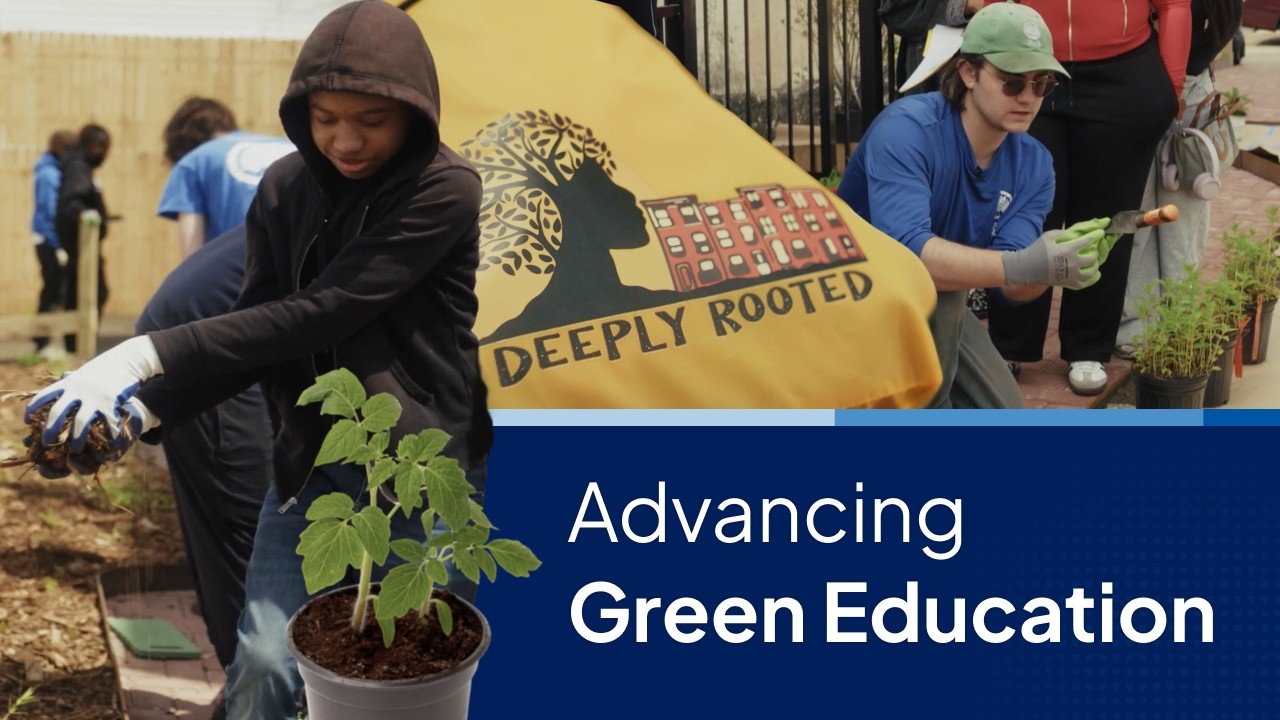
Going on its second year is LeadIN, an educational arm of Deeply Rooted aimed at teaching young people about the healing power of nature—by giving them opportunities both to get their hands dirty, and to advocate for what they and their neighborhoods need. Through four-week summer sessions and year-round after-school activities, high school students in West and Southwest Philadelphia can earn a stipend while learning and doing.
Some days, they’re on Penn’s campus, visiting a biology lab or interacting with a speaker like Eugenia C. South, MD, MS, the Ralph Muller Presidential Associate Professor of Emergency Medicine, associate vice president of Health Justice, and executive director of the Center for Health Justice at Penn Medicine, who spent one morning walking them through the meaning of health equity. Other days, they're going on a field trip to the Sankofa Community Farm at Bartram’s Gardens or the John Heinz National Wildlife Refuge at Tinicum, creating personal care products from natural ingredients, or checking out the plants and creatures living at Penn’s BioPond. And there are plenty of chances to actually “touch grass”: taking a break from always-on digital lives to get outside; dig holes; and plant, water, and nurture flowers and trees. “I didn’t know how much I enjoyed being outside until this program,” said Makayla Robinson, 16.
Activating parks—and young people
For the current LeadIN teen cohort, the 2025-26 school year was an opportunity to not only learn about the value of green spaces, but to find ways to make the new Deeply Rooted MiniParks central hubs for communities to preserve and cherish. The small greenspaces are a major initiative of Deeply Rooted’s Collaborative—a network of community partners, including faith-based organizations, community development corporations (CDCs), neighborhood nonprofits, and others that make up Deeply Rooted. The organization also partners with PHS, which contracts with landscapers for installation and heavy-duty jobs like regular watering. (Deeply Rooted and its community partners also form stewardship committees with individuals in the neighborhood to tend to the parks.)
The site which would become Serenity Park was selected and co-designed in partnership with The Church of Christian Compassion, Community of Compassion CDC Inc., Global Thinking Initiatives Inc., Boys’ Latin of Philadelphia, Cobbs Creek Park Ambassadors and Motivated Community Resource Center.
The youth in LeadIN dreamed up the activation events, which help neighbors see how the parks can be spaces not only for relaxation, but also for events—birthday parties, meetups, even yoga among the plants and birds and puffy clouds. “This is them activating the space,” marveled Janaiya Reason, community engagement manager at Deeply Rooted, as she observed the yoga, painting, and pizza at the Serenity Park activation planned by 15-year-old David Vaan and several other students. “It’s a wonderful thing for them and for the neighborhood.”
The LeadIN participants spent their sessions throughout the school year learning how to plan an event, choose activities that would draw in community members to enjoy the space, delegate tasks, “pitch” their proposal to the program’s staff (serving as mock “investors”), figure out a budget and shop for supplies, and advertise the big day—all leadership skills they developed.
“We really tried to be as hands-off as possible,” said James Wright, MBA, strategy and operations project manager for Deeply Rooted and one of the staff overseeing LeadIN. “If they fail, they fail forward.”
Vaan said everyone on his team collaborated on the script for the pitch that outlined their plans for the activation event, from which activities to offer to how to market it. “One of the main things I learned was how to present in front of people, and interact with people on a team,” he said near the close of the event, as he and other LeadIN teens helped clean up and put away chairs and tables.
Growth mode
Although the role of nature in health is LeadIN’s prime focus, the program has secondary goals: helping youth develop leadership skills and setting them up for successful careers and lives as engaged citizens. The students learn how to work as a team and how to use new technologies, to dream big while developing a plan and making it happen.
Over the past summer, the LeadIN teens learned about college life from a panel of current Penn students who shared their experiences. The program has also held sessions about managing money, informational interviewing and networking, paying for college, exploring career paths, and more. “They may not all want to do environmental justice work,” said Wright, “but we hope they learn it can be included into everyday life.”
With the start of a new school year, LeadIN is embarking on its second year of programming. To date, 18 students have been trained through the program, and as some teens move on when they finish high school, new learners join continuing students. Part of the program’s successful formula is its family atmosphere, as participants become a close-knit group who work together and celebrate each other. “It’s really the longitudinal aspect that stands out to me, building the relationships,” said South. “Seeing some of them from last summer to now, they’ve grown more confident and supportive of their peers.”
That growth is evident in Robinson. She joined LeadIN to have something to do—“I’m not an in-the-house person”—and ended up not only helping to launch a new park that’s walking distance from her home, but also learning about environmental justice. “I was surprised how much nature actually affects your physical health, not just your mental health,” she said. “It’s definitely helped me advocate for more green space.”
Even if Robinson and her fellow LeadIN participants end up doing something entirely different for their careers, the program staff believe that early and frequent exposure to nature will likely inspire them to keep greening their communities and motivating others to follow in their footsteps.
Today, Serenity Park looks different than it did during the activation event. Flowers are blooming, herbs are ready for harvesting, and the sapling’s green leaves are shifting to bright gold with the advent of autumn. It’s easy to envision how the space will look a decade from now, flourishing and a popular hangout spot for the community. And in those ten years, the teens who helped welcome it into the world will be well into young adulthood, carrying the lessons they learned through LeadIN to keep making their communities greener and healthier for generations to come.