
Back on her feet and breathing
Bri Iacona, a mother and teacher, made a remarkable transition from Lung Rescue to lung transplant after she had severe COVID complications in 2021.
Bri Iacona’s five-year-old son is too young to remember the four months when he didn’t see his mom, while doctors and medical staff worked to save her life. But every Dec. 28, Brayson knows what to do when the birthday cake is brought out.
“Happy Birthday to Mommy’s lungs,” he belts out.
It’s been four years. Iacona’s survival will always be part of her family’s story.
ECMO
Iacona, a fourth-grade teacher, had just turned 30 when she became gravely ill with severe COVID-19–associated acute respiratory distress syndrome at the start of the 2021-2022 school year.
She had recently gone back to teaching, after 18 months at home with her baby, and had received her first dose of the COVID vaccine. But before the first week of class was over, she contracted the virus.
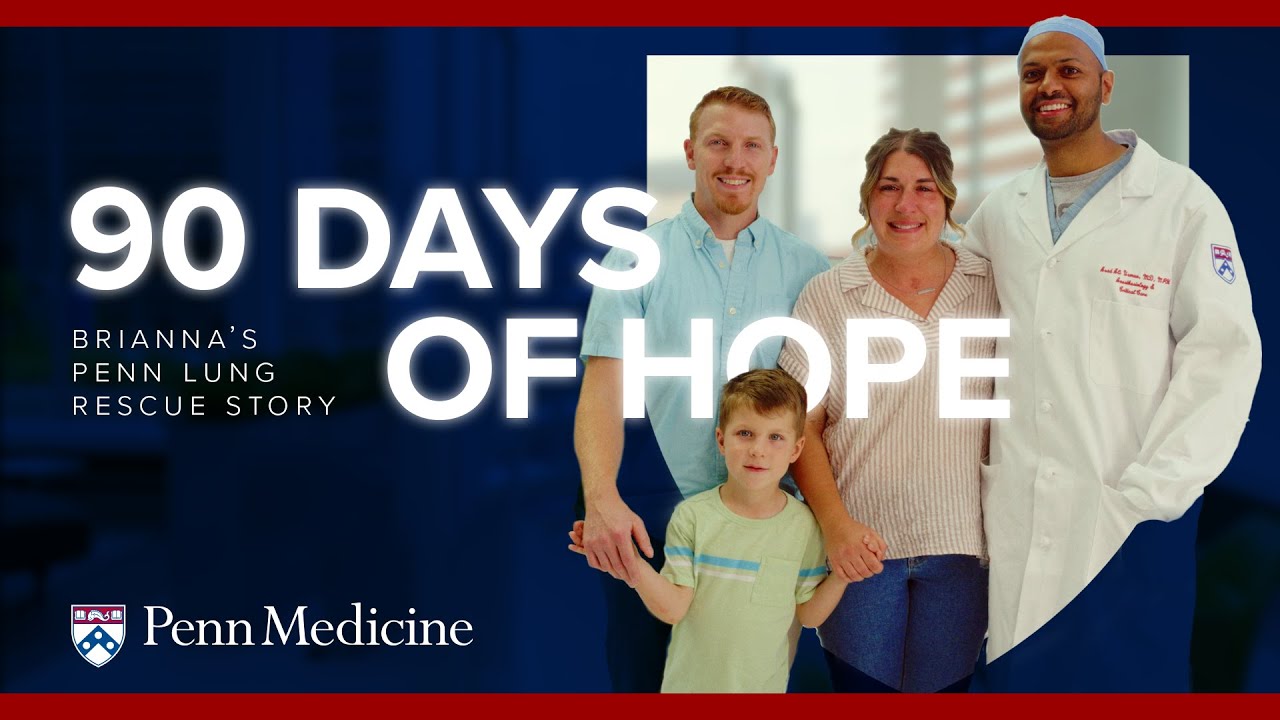
Within days, the disease progressed so quickly that she was put on a ventilator to force air through her lungs, and when that didn’t work, she was put on extracorporeal membrane oxygenation (ECMO), a machine that temporarily replaces a patient’s heart, lungs, or both when their organs are too weak or sick to function on their own.
Iacona was placed on venovenous ECMO, which solely replaces the function of the lungs. ECMO isn’t a treatment; it’s meant to buy time while doctors work to reverse lung failure. Blood is drained from the patient’s body, pumped through a filter that puts oxygen in the blood and removes carbon dioxide as healthy lungs would, and then pumped back into the patient.
The Penn Lung Rescue team had kept Iacona alive in the Penn Presbyterian Medical Center’s Heart & Vascular Intensive Care Unit for two months using this most advanced form of life support for lung failure. But by the end of October 2021, they knew that a double lung transplant was her only chance for survival.
“Sometimes, patients’ lungs are so sick and there’s so much fluid in them that the ventilator can’t work. It’s like they’re drowning. Their lungs are so damaged, and the ventilator can’t oxygenate them,” said cardiovascular anesthesiologist Asad Usman, MD, MPH, a member of the lung rescue team who coordinated Iacona’s ECMO treatment for months along with team director Audrey Spelde, MD, and anesthesiologists Jacob Gutsche, MD, and William Vernick, MD.
Once doctors saw that Iacona’s lungs weren’t making any recovery, they started working toward transplant. But she needed to be up and moving to qualify—and she wasn’t even awake. She had been heavily sedated and medically paralyzed for several weeks to reduce the amount of oxygen her body needed and allow her lungs to rest.
“The lung transplant team wanted her to be functional, awake, and have a decent amount of strength, because lungs are scarce and the demand is so high they have to ensure that they only list patients with the highest chance of survival after transplant,” said Kelsey Quinonez, BSN, RN, CCRN, a critical care nurse in the HVICU. “That was her one barrier holding her back from transplant.”
Up and moving in the ICU
The timing was just right for Quinonez, who, with fellow HVICU nurses Elizabeth Haemmerle, BSN, RN, CCRN, and Dolores Risica, BSN, RN, CCRN, had recently kicked off a project to get ventilated patients up and moving earlier to improve their outcomes. Studies show that immobility can lead to cardiovascular decline, muscle weakness, decreased cognitive function, and increased risk of delirium. Mobilizing vented patients earlier has shown to improve their outcomes, including reducing their time spent on the ventilator and in the ICU, Quinonez said.
Since this was a new practice in the HVICU, the nurses worked closely with physical therapist Kathryn Siciliano, PT, DPT, occupational therapist Abigail Sossaman, MOT, OTR/L, and their teams, to learn the skills necessary to safely mobilize these complex patients.
The HVICU nursing staff, in partnership with physical and occupational therapists, respiratory therapists, and perfusionists— specialists who manage the ECMO circuit—got to work bringing Iacona out of sedation and getting her moving—while still on the machine.
At that point, “she was literally not able to lift a finger,” Quinonez said. “That’s how deconditioned she was from laying in a bed for weeks and weeks.”
The team started by lifting her arms and legs, and within a couple of weeks, she was able to sit on the side of the bed with assistance. Just getting her into a seated position took a crew of six people monitoring her vital signs, IV lines, the ventilator, and the ECMO circuit.
They got her on a rehab bike that she could use from her bed, even with ECMO tubes in her legs.
The whole time, Iacona couldn’t speak because she had a breathing tube in her trachea connecting to the ventilator. Her husband Phil and the care team used a chart with letters and common expressions on it for her to communicate, and the nurses put photos of her family on the light above her bed to keep her motivated.
Then, one Friday, Iacona’s ECMO circuit began to fail; a large blood clot had formed in her heart. Usman, along with cardiac and interventional cardiology surgeons, performed an emergency operation to quickly exchange the mechanical circuit.
That was the first life-saving surgery she underwent that year. In late 2021, she was finally ready to be evaluated for a bilateral lung transplant.
A life-saving transplant
The director of thoracic transplantation at HUP, performed her double lung transplant a few days after Christmas.
Gutsche, associate chief medical officer of critical care at Penn Medicine, said Iacona was the first patient brought to Presbyterian for lung rescue who bridged to being awake and participating in physical therapy on ECMO, and then to transplant.
Going home
In March of 2022, nearly six months after entering the hospital, Iacona got to go home.
She doesn’t remember anything from her 97 days on ECMO; even when she was awake for the mobility work, she was still so critically ill, and on sedative and pain medications. One thing she’ll never forget is the feeling of her son in her arms when she finally came home.
“He ran into the room screaming ‘Mommy!’” Iacona said. “The feeling was indescribable.”
She knows it sounds like a cliché to say that she wakes up and goes to sleep feeling grateful to be alive, to be healthy, and to have her family. But that’s how it is. Picking out a Christmas tree with her family, getting to be a teacher, and hearing her 5-year-old call out, “I love you, Mommy—You’re the best in the world,” all remind her how lucky she is.
“I’m going to really soak it in,” Iacona said, “because this is my second chance.”
An earlier version of this story was published in 2022.