
How Penn Medicine is transforming pharmacy through innovation and patient-centered care
The pharmacy system of the future is here at Penn Medicine: a powerful union of advanced tech with human expertise, improving patients’ health.
A small clear box holding dozens of white pills rises toward a stainless-steel cylinder.
Pfft.
A single pill is sucked onto the end of the cylinder.
Whir. Whirrr.
The cylinder rotates and releases the pill into a clear plastic baggie attached to a carousel. Labeling is applied and the carousel rotates.
Pshh.
A robot arm plucks the baggie from the carousel, rises, and turns, dropping the baggie into a chute, which leads to conveyor belts, and baskets, and pneumatic tubes that run through the building to patient floors at Penn Presbyterian Medical Center. It’s a marvel of technology and automation that is making health care safer and more efficient. And it’s paired with the equally essential human touch of pharmacists who check and recheck the medication along the way—and so much more.
The journey of this single pill exemplifies Penn Medicine’s investment in growing an innovative pharmacy system that is integrated into every level of care. Advances in automation, artificial intelligence, and delivery technology are making care easier and more personalized, while also improving efficiency. Leveraging this technology, even as many medications become more complex, today Penn Medicine pharmacists are able to spend more time directly helping patients and work seamlessly with doctors and nurses.
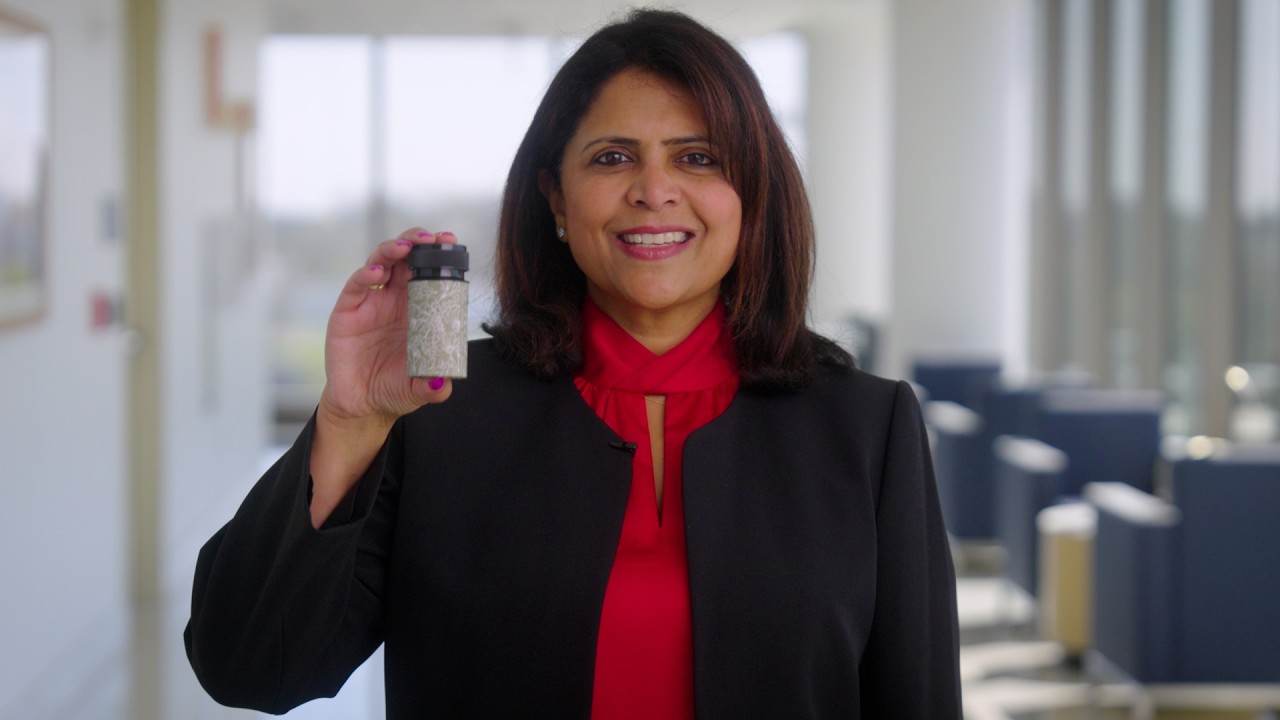
“The traditional role of pharmacists has moved beyond dispensing medications—we really touch every patient that walks in the hospital,” said Penn Medicine Chief Pharmacy Officer Nishaminy Kasbekar, BS, PharmD.
What’s old is new, foundationally
Steps from the entrance of Penn Presbyterian, a handful of people—most heading home from an emergency department visit or a surgical procedure—are queued up to have prescriptions filled. On the other side of the glass, nearly 20 pharmacists are working in an assembly line coiled around a large table. Some are sorting, counting, and packaging medications. Others are working directly with patients at the glass. The suite is lined with boxes and bottles on shelves, like the stacks of a library. This is the traditional scene that traces back to the beginning of pharmacy at Penn Medicine when Pennsylvania Hospital opened its Apothecary centuries ago, and likely the image most people associate with a pharmacy.
But now, the hospital’s retail pharmacy is one of several crucial links that connect pharmacists into the larger chain of a patient’s care, with a demonstrated impact on their health. As the handoff from care in the hospital to care beyond, the hospital retail pharmacy allows patients to skip the extra stop on the way home to pick up medications. Research shows this offers patients the opportunity for better outcomes than if they went to a commercial retail pharmacy.
“We have shorter turnaround times, we have higher medication adherence rates. We have a higher patient satisfaction score than our competitors in the space,” said Kasbekar. “We want the patient to walk out with the script so they could just go home.”
Kasbekar carries an intensity that spills over as she explains all the ways pharmacy teams touch care throughout the health system. She’s an evangelist as much as an innovator. She is the first person at Penn Medicine to hold the title of chief pharmacy officer, a position created three years ago in recognition of the need to build a systemwide pharmacy strategy. Before taking the role, Kasbekar had been with Penn Medicine for three decades. It was a journey that started in college when she veered from the pre-med path her immigrant parents expected, toward pharmacy with an understanding that knowing what drugs do in the body is a crucial part of care.
“It was a different type of medicine for me,” Kasbekar said.
Kasbekar’s passion spills out beyond the confines of Penn Medicine. She recently served as the president of the American Society of Health-System Pharmacists, a national vantage point from which she surveyed best practices and tracked new strategies that work for other health systems—such as including pharmacists at every level of care.
‘My other hospital doesn’t do that’
Patients are often surprised as they come to realize how deeply pharmacists throughout the hospital system are integrated into their care. For example, pharmacy technicians like Angelica Bonilla are at the bedside delivering and explaining medications, and helping make sure patients can follow the regimen once they’re discharged.
Bonilla and her colleagues possess that rare ability to fluently speak with providers, insurers, and patients. As a result, they often become de facto patient advocates, cutting through insurance red tape and looking for ways to make prescriptions cheaper.
“A lot of times, when it's a new patient, and they're not used to this, they’re like, ‘Oh, my other hospital, they don’t do that,’ and I’m like, ‘Yeah, we do it here,’” said Bonilla.
That’s typically the moment patients realize how much work is happening behind the scenes to ease and elevate the quality of their care. As potential roadblocks are handled by pharmacy techs, patients are more likely to follow their provider’s instructions and less likely to be readmitted with a complication.
Pharmacists are also using more efficient means to communicate with providers. For example, the Curatr app within Epic is a texting platform that enables teams to discuss treatment in a secure chat. This allows doctors to catch up on the details of a case during the spare moments in between seeing patients.
“We’re not annoying [doctors] with a phone call every five minutes. We’re meeting providers where they want to be met. They’re rounding, they don't want to be bothered with phone calls,” Kasbekar said.
The health system is also looking into an AI platform that would handle prior authorizations with insurance companies. It promises to compress a process that normally takes a technician 2-4 hours into less than 10 minutes, she said. The pharmacy operation is marked by layers of checks and expertise. At Penn Presbyterian, Clinical Pharmacy Specialist Karrisa Chow, PharmD, BCPS, rounds with internal medicine doctors, discussing patient cases and helping craft medication plans, guided by a simple question: “Which treatment is going to be the best one for this specific patient?”
Many patients come into the hospital already on medications, then more are prescribed during their inpatient stay, and then more at discharge. Chow’s role is to take a step back and look at the bigger picture, removing duplicative medications and simplifying the regimen.
“There’s data to show that when a pharmacist is involved in care, you have less readmissions, you have patients that are taking their medications and decreased side effects,” said Chow.
The cool reality of revolutionary medications
A few miles away from several of Penn’s hospitals, a former warehouse is now the home to Penn Medicine’s Specialty Pharmacy, handling medication for complex and long-term conditions.
There are fridges everywhere. Some are shoved into alcoves that once held desks. Some just barely fit behind doors. Two entire walls are lined with fridges. And in the middle of this cool mayhem is a table stacked with boxes ready to pack and ship reading: RUSH! TEMPERATURE SENSITIVE MATERIAL.
This is the reality of a health system pharmacy operation in the age of new classes of drugs, many of which must be kept cold until they are administered. The Specialty Pharmacy allows for a greater ease of access to leading-edge treatments, which might previously have demanded a hospital stay or clinic visit.
“One of the first drugs was a specialty drug that cured hepatitis C. And once the marketplace saw, ‘Wow, these are drugs that can cure diseases,’ it kind of took off from there,” said Joe Favatella, PharmD, MBA, the chief administrative officer of Penn Medicine specialty pharmacy services.
The Specialty Pharmacy is helping patients with increasingly complicated conditions gain access to advanced drugs and therapies while remaining closely connected in one system with their clinical team—instead of relying on outside companies.
“We do many of the complex medications here: oncology drugs, multiple sclerosis drugs, and then all the GLP-1 medications are plugged into the specialty pharmacy program, which gives those patients wraparound services that they otherwise wouldn't get if they were filling these prescriptions in other channels,” said Favatella.
This wraparound care includes helping patients who may now need to take an increasingly active role in administering their own treatments. Pharmacists and techs now more commonly call patients at home to follow up with help, or to check if refills are needed, or just to check in to see if they have any questions.
“A lot of the drugs are now becoming patient administered with an injection into their thighs or something like that, where they don’t need to go into an infusion suite for an IV,” said Laura Hallisey, PharmD, MBA, the associate director of pharmacy ambulatory services at Penn Medicine.
Nearly half the square footage is broken up into cubicles where pharmacists work the phones or live chat with patients on computers. In addition to walking patients through treatment, part of the role, again, is advocating for patients with insurers and drug manufacturers to lower the cost whenever possible.
“It's a very vulnerable time to be a patient, and we’ve designed a program here to handle every barrier that the patient could have,” Favatella said.
There is also greater efficiency in an expanded and cohesive health system pharmacy operation. Favatella says it typically takes patients between 14 and 21 days to get many of the drugs handled by this facility when they go through a traditional retail pharmacy. At Penn, patients typically receive the drugs in three days, aided by a homegrown text-messaging system called RefillExpress, that makes it easier for patients to place orders, and for pharmacists to fill them fast. Everything is fully integrated with clinics and the medical record. Ultimately, this means people feel better, faster. And it’s cheaper.
Efficiency is a necessity amid a nationwide pharmacist shortage that is only growing more acute, as fewer people study to be pharmacists. Automation, AI, and efficient communication tools like RefillExpress are a crucial way of liberating pharmacists to spend more time focusing on patients and offering the precise care they need, Kasbekar said.
Walking through a door at the end of the room full of fridges, the trajectory of this health system pharmacy operation is made clear in a mainly empty space. Plastic sheeting hangs above a bare concrete floor that vibrates with the continuous hum of industrial freezers. It’s still under construction, but when complete the space will double the footprint of this pharmacy—the second doubling of space in five years.
The expanded space will accommodate the exponential growth of GLP-1 drugs, with additional refrigeration and room to prep and box these and other medicines that require a cold supply chain. These drugs already require upwards of 4,000 ice packs every hot summer day—a frosty effort to get medications to patients. (Despite these energy-intensive needs, Penn Medicine’s systems are designed with sustainability in mind, as part of a larger systemwide commitment to efficiency.)
The creative disruption of pharmacy
Reshaping the role of pharmacists in care is a constant balancing act of growth and efficiency, even as new treatment technologies come along—like someday 3D-printing multiple pills into one, as one example Kasbekar envisions.
At Penn Medicine, the present and future of pharmacy are a marriage of people and technology, illustrated by the journey of the little white pill.
The giant machine that sent the pill on its way to a patient’s bedside is housed in a large basement suite. The machine operates on a footprint about the size of a bedroom. What used to take six people working overnight is now done in just four hours by the machine that dispenses medication, one dose at a time, for the hundreds of people being treated in the hospital.
“It’s also the accuracy,” said Parwana Shah, PharmD, RPH, director of pharmacy operations at Penn Presbyterian Medical Center. “You’re taking out the human error of anything that’s being dispensed.”
Steps away, another machine dispenses non-pill medications, and each machine uses barcodes to track and measure each dose for more precise, AI-assisted inventory management.
Another area of efficiency and automation is supply chain management—the equivalent to moving meds from superhighways onto small neighborhood streets and then onto doorsteps, sometimes literally. Kasbekar says she is interested in medications being delivered by drone, but there is still a lot of red tape to be sorted before such a service could even be tested. In the meantime, a courier service delivers medications to patients who qualify for delivery.
This creative disruption isn’t limited to AI and drones. Penn Medicine is also working with Mark Cuban and Cost Plus Drugs to buy the top 100 most frequently dispensed generics at a discount.
“With the savings that we’re garnering there, we’re reinvesting in these wraparound services that our pharmacies are providing,” Kasbekar said. The big goal is to deliver ease and the highest quality of care to patients. As pharmacy teams benefit from efficient technologies, they can lean into a future of more personalized care that depends on a deeper understanding and connection with patients.
“Pharmacists are lifelong learners; this is not a static area. New drugs are coming out constantly,” said Kasbekar. “That’s what I think makes it fun too, because it's an ever-evolving field of medicine.”